Docked vs. Dockless E-Scooters: Which Model Works Better?
*We may earn a commission for purchases made using our links. Please see our disclosure to learn more.
Shared e-scooters have become an established part of urban transportation, connecting riders to transit, filling gaps between stops and destinations, and replacing some short car trips. Yet a program’s success depends on more than the scooters themselves. Parking, charging, maintenance, distribution, accessibility, pricing, and street design all shape whether the service helps a city or creates new problems.
The main choice is between docked and dockless systems. Docked e-scooters must be picked up and returned at fixed stations or locking points. Dockless scooters may be found and parked throughout an approved area, although many modern programs now require geofenced parking zones, painted corrals, or end-of-trip photographs.
Neither model is universally better. Docked systems provide order and predictability, while dockless systems maximize coverage and convenience. In many U.S. communities, a hybrid model offers the strongest balance.
“In 2025, people took 150 million trips on shared bikes and scooters in NACTO member cities.”
— National Association of City Transportation Officials, Shared Micromobility in NACTO Member Agencies: 2025 Trends [1]
Key Takeaways
- Docked systems usually provide better parking control, clearer pickup points, and less sidewalk clutter.
- Dockless systems offer greater door-to-door convenience and can expand without a costly station network.
- Docked networks perform poorly when stations are sparse, full, empty, or placed away from demand.
- Dockless fleets require firm parking rules, equitable deployment, maintenance, battery service, and rebalancing.
- Dense downtowns, campuses, transit hubs, and tourist districts often benefit from docks or mandatory hubs.
- Hybrid systems can preserve flexible travel while directing scooters to designated parking and charging locations.
Recommended E-Scooters to Buy on Amazon
Shared scooters suit occasional trips, but ownership may be more practical for frequent riders. Amazon availability and specifications can change, so confirm the current listing, local laws, rider-weight limit, warranty, and safety certification before purchasing.
1. Segway Ninebot MAX G3 — Best for Longer Commutes


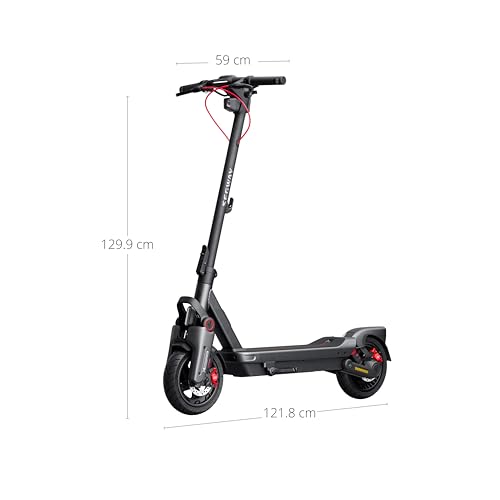
The Segway Ninebot Max G3 is one of the quietest electric scooters designed for riders who value both silence and performance. Featuring a powerful 2000W peak motor, a top speed of 28 mph, and a max range of 50 miles, this scooter delivers smooth, noise-free rides perfect for city commutes or long-distance travel. With dual hydraulic suspension, advanced stability systems, and self-sealing 11-inch tires, the G3 ensures comfort and safety while keeping road noise at a minimum. Its fast charging system (3.5 hours standard, 2.5 hours with optional DC charger) makes it ideal for daily use. Certified under UL-2272 safety standards, it’s a reliable option for adults and teens seeking premium quality and peace of mind.
The MAX G3 is designed for riders prioritizing range and comfort. Its Amazon listing advertises speeds up to 22 mph, range up to 43 miles under stated conditions, front hydraulic and rear spring suspension, 10-inch tires, and dual braking. It is relatively heavy, making it better for ground-level storage than frequent stair carrying.
- Quiet Ride: Low-noise motor and smooth suspension make it one of the quietest electric scooters for urban commutes.
- Long Range: Up to 50 miles per charge, ideal for extended rides without frequent recharging.
- Comfort & Stability: Dual hydraulic suspension and self-sealing tires absorb shocks for a smoother, quieter journey.
- Premium Price: Higher cost compared to entry-level scooters.
- Heavy Frame: Weighs more than lightweight commuter models, less portable.
- Non-Returnable: Limited return options due to hazardous material regulations.
2. NIU KQi3 Pro — Best Balanced Commuter


The NIU KQi3 Pro Electric Scooter is designed for urban commuters who want a reliable, smooth, and efficient ride. With a 31-mile range and a top speed of 20 mph, this scooter balances performance with practicality. Its foldable frame makes it easy to carry and store, while the pneumatic tires ensure a comfortable ride on various terrains. Whether you're heading to work or cruising around town, the KQi3 Pro delivers a dependable and enjoyable experience.
The KQi3 Pro combines a wide deck, stable geometry, a rated 350-watt motor, a listed top speed of 20 mph, and claimed range up to 31 miles. Front and rear mechanical disc brakes work with electronic braking. It suits riders wanting a substantial urban commuter without moving into a heavier performance category.
- Long Range: Travels up to 31 miles on a single charge, ideal for daily commuting.
- Smooth Ride: Pneumatic tires and ergonomic grips provide comfort on different surfaces.
- Portable Design: Foldable frame allows for easy storage and transport.
- Limited Speed: Maxes out at 20 mph, which may feel slow for some riders.
- Fixed Handlebar: Lacks height adjustability for personalized comfort.
- Mixed Reviews: Some users report durability concerns over time.
3. GOTRAX G4 — Best Practical City Commuter


The Gotrax Electric Scooter for Adults is a powerful, long-range commuting scooter designed for daily travel and delivery services. Featuring a 500W motor, it can reach speeds of up to 20 mph and cover a maximum range of 42 miles (depending on the model). Its 10" pneumatic tires provide excellent stability and shock absorption, ensuring a smooth ride on different terrains. The scooter also boasts a removable 36V 10.4AH battery that offers great value for extended usage, and it includes safety features such as an electric code lock and a cable lock for easy security. With its foldable design, digital display, and LED lights, the Gotrax electric scooter makes commuting or delivery tasks more convenient and efficient.
The G4 is listed with a 500-watt motor, speeds up to 20 mph, claimed range up to 25 miles, and 10-inch pneumatic tires. It is suited to moderate daily trips. Compare the exact version shown on Amazon because specifications and suspension packages may differ between updates.
- Long range: Up to 42 miles on a single charge, making it ideal for long-distance travel and delivery.
- Powerful motor: The 500W motor allows for smooth acceleration and a top speed of 20 mph.
- Pneumatic tires: 10" pneumatic tires offer better stability, comfort, and shock absorption, especially on rough roads.
- Weight: It weighs 36 lbs, which may be heavy for some users to carry.
- Charging time: A full charge can take several hours, which might not be ideal for high-frequency use.
- Price: On the higher end for budget-conscious buyers, especially for the longer-range models.
4. Hiboy S2 — Best Budget-Oriented Choice


The Hiboy S2/S2R Plus Electric Scooter is built for commuters who want a reliable and powerful scooter that combines speed, range, and safety. Powered by a 350W motor, it reaches speeds up to 19 mph and offers a 17-mile range on a single charge. Featuring a double braking system with disc brakes and eABS regenerative anti-lock braking, it ensures a smooth and safe ride. The solid rubber tires provide durability and a stable ride, while the Hiboy app allows you to lock your scooter, customize settings, and track your performance. With a portable design and the ability to fold for easy storage, it’s an excellent choice for daily commuting or quick city trips.
The Hiboy S2 offers a listed 350-watt motor, speeds up to 19 mph, claimed range up to 17 miles, solid tires, app controls, and disc plus electronic braking. Solid tires reduce puncture maintenance but transmit more vibration, making the model better for smoother pavement and shorter trips. The Amazon listing states that it passed UL 2272 testing.
- Powerful Performance: 350W motor with 19 mph top speed
- Safety Features: Double braking system with disc and eABS brakes
- App Integration: Control settings and lock the scooter via the Hiboy app
- Weight: At 29.5 lbs, it may be heavy for some users to carry
- Range Limitation: 17 miles may not be enough for very long commutes
- Seat Sold Separately: The extra detachable seat is not included in the base package
What Is a Docked E-Scooter System?
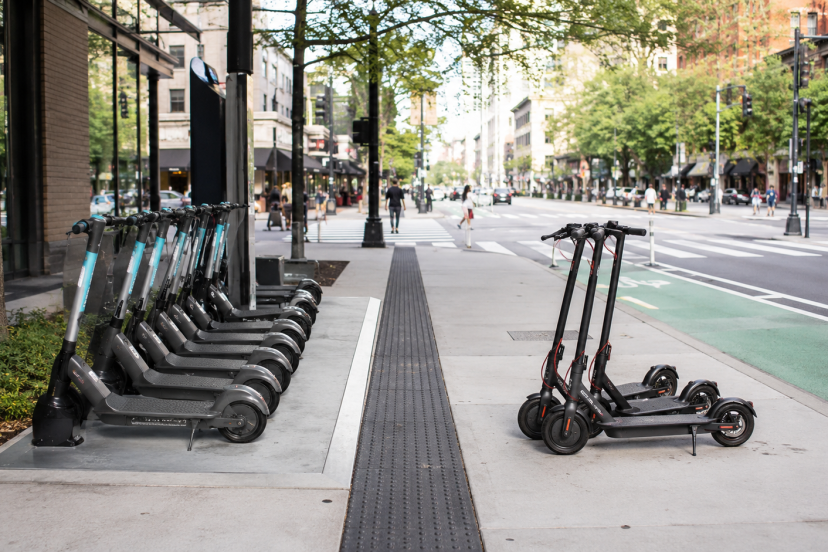
A docked system requires riders to start and end trips at fixed locations. A station may physically lock scooters, supply power, confirm returns, or simply organize parking. Riders know where vehicles should be available, pedestrians know where they belong, and operators can focus maintenance and charging around defined sites.
The weakness is dependence on station density. Riders may have to walk several blocks when docks are scarce. Full destination stations create “dock anxiety,” while empty origin stations make the service unreliable. Operators must monitor demand and rebalance scooters between locations.
What Is a Dockless E-Scooter System?
A dockless system lets riders find a scooter through an app and leave it at an approved location within the service area. Although early programs allowed nearly unrestricted parking, most current systems use geofencing, no-parking zones, corrals, required photos, incentives, or fines.
The main advantage is convenience: a scooter can be closer to the starting point and left nearer the destination. Operators can also launch and adjust coverage without constructing stations.
The challenge is control. Scooters may cluster in busy areas, disappear from lower-demand neighborhoods, or obstruct curb ramps, doors, bus stops, and sidewalks. Cities therefore need enforceable parking standards and fast response requirements rather than relying on app instructions alone.
Docked vs. Dockless E-Scooters at a Glance
| Factor | Docked System | Dockless System |
|---|---|---|
| Convenience | Depends on station density | Usually stronger door to door |
| Parking order | Strong | Depends on rules and enforcement |
| Initial cost | Higher | Generally lower |
| Expansion | Slower | Faster |
| Charging | May be built into docks | Often uses battery swaps or collection |
| Rebalancing | Predictable station-to-station work | More dispersed |
| Accessibility | Easier to control | Greater obstruction risk |
| Coverage | Concentrated | Potentially broader |
| Reliability | Clear locations, but docks may fill or empty | Flexible, but availability varies |
| Best setting | Dense corridors and major destinations | Broad or changing service areas |
Which Model Is More Convenient?
Dockless systems generally win on pure door-to-door convenience. Riders do not have to plan around a station map, which is useful in neighborhoods with dispersed destinations or limited curb space.
Docked systems can feel more dependable because users know exactly where to search and where a trip can end. Their performance depends on a closely spaced network with enough capacity. NACTO reported that Vancouver’s docked e-scooter system recorded eight trips per vehicle per day in September 2025, the highest utilization among the e-scooter systems in its member-city analysis. This does not prove that docks always increase ridership, but it demonstrates that a well-designed docked network can achieve strong use.
Which Model Manages Public Space Better?
Docked systems have the clearest advantage in curb and sidewalk management. Fixed areas keep scooters grouped, upright, and out of pedestrian paths. Cities can inspect known locations and address recurring problems more easily.
Dockless parking can still work when cities use on-street corrals, lock-to requirements, parking photographs, geofenced ride termination, and meaningful penalties. Designated bays preserve much of the flexibility of dockless travel without allowing scooters to be left anywhere.
Accessibility is central. Transportation research recommends penalties for unauthorized parking and accessible infrastructure around stations. A misplaced scooter can block an accessible route, especially for wheelchair users and people with vision impairments.
Which Model Costs Less?
Dockless programs usually cost less to launch because they avoid a large investment in stations, electrical connections, permits, and curb construction. Operators can test demand and modify service boundaries quickly.
However, long-term dockless operations can be labor-intensive. Workers may need to swap batteries, collect damaged units, correct parking, and redistribute vehicles over a wide area. Initial infrastructure savings may be partly offset by recurring logistics costs.
Docked systems require more capital but can centralize parking, inspections, and charging. Powered docks may reduce collection trips made solely for charging. The better financial model depends on station costs, labor, utilization, electricity access, fleet lifespan, and rebalancing requirements.
Charging, Maintenance, and Rebalancing
Every shared electric fleet must keep charged vehicles near likely riders. Dockless systems often use removable batteries or field collection. Battery swapping keeps scooters available, but staff still travel throughout the service area.
Charging docks let riders return scooters directly to power and can simplify inspections. Their limitation is capacity: stations may become full at destinations or empty after a commute peak.
Recent transportation research examines mixed systems in which riders may leave scooters at charging stations or approved dockless locations. Incentives can direct low-battery scooters to charging hubs while preserving flexibility for other trips.
Equity and Neighborhood Coverage
Dockless fleets can enter underserved neighborhoods without waiting for station construction, but flexible deployment does not guarantee equity. Operators may still concentrate vehicles where revenue is highest. Cities may need minimum neighborhood service levels, reduced fares, cash or prepaid payment options, and response-time standards.
Docked systems can create durable infrastructure, but poor station placement may favor downtown, affluent, or tourist areas. Stations should be located near housing, jobs, schools, healthcare, transit, and everyday services.
Both models can exclude people who lack smartphones, payment cards, accessible vehicles, or confidence riding. The better system is the one designed around access, not trip totals alone.
Which Model Is More Sustainable?
E-scooters produce no tailpipe emissions, but total environmental performance depends on manufacturing, vehicle lifespan, charging, collection, and the trips replaced. A scooter trip replacing driving usually provides more value than one replacing walking or transit.
Dockless systems may create more collection and rebalancing mileage. Charging docks can reduce some of that work, although station construction also uses materials and energy. A recent multi-city life-cycle assessment found that operational efficiency, vehicle longevity, local electricity, and modal substitution strongly affect results.
Cities should measure fleet lifespan, collection mileage, battery practices, use rates, and car-trip replacement. “Docked” or “dockless” alone does not determine which program is greener.
Safety, Reliability, and Data
Parking design affects pedestrian safety, but riding safety depends more on protected infrastructure, speed, vehicle condition, lighting, and rider behavior. A docked fleet is not automatically safer on the road.
Docks can simplify inspections because scooters return to known points. Dockless operators can use connected-vehicle data to flag falls, unusual movement, low batteries, or maintenance needs. Cities should track crashes, parking complaints, blocked-access reports, response times, neighborhood distribution, pricing, and trip completion—not only total rides.
Why Hybrid Systems May Work Best
The choice is no longer limited to fixed docks or unrestricted parking. A hybrid program can use physical charging stations at transit hubs, geofenced or painted corrals in busy districts, and more flexible parking where sidewalks and demand patterns allow it.
This approach concentrates scooters where demand is predictable, reduces clutter in sensitive areas, and preserves coverage beyond the station network. It also gives low-battery vehicles a pathway to charging without requiring every scooter to be collected.
Hybrid systems still need enough parking locations. Mandatory hubs become frustrating when approved zones are scarce, full, poorly marked, or far from destinations. The network must be planned around actual trips.
Which Model Works Better?
Docked or hub-based systems are often best for dense downtowns, rail stations, campuses, stadium districts, and places with heavy pedestrian traffic. Their success depends on close station spacing and enough capacity during peak periods.
Dockless systems are often better for broad service areas, lower-density neighborhoods, pilots, and cities with rapidly changing demand. Their success depends on parking enforcement, equitable distribution, responsive maintenance, and efficient battery operations.
For many U.S. cities, a hybrid model works best. Docks can control parking at major destinations while regulated dockless zones extend service farther. The best model is the one that connects useful destinations without shifting operational burdens onto pedestrians, public agencies, or underserved neighborhoods.
What to Check Before Buying
Do not choose solely by maximum speed or advertised range. Real range changes with rider weight, hills, temperature, tire pressure, stops, and riding mode. Prioritize reliable brakes, visible lighting, appropriate tires, a stable stem, a manageable carrying weight, and adequate water resistance.
Confirm that the complete electrical system is certified to an appropriate standard such as UL 2272. Use only the approved charger, inspect the folding mechanism and tires, and never charge a damaged or unusually hot battery. Check local rules for speed, sidewalks, bike lanes, helmets, rider age, and parking.
Final Verdict
Docked e-scooters work best where predictable parking, charging, and transit integration are priorities. Dockless systems work best where broad coverage and door-to-door convenience matter most. Neither succeeds without thoughtful operations and regulation.
The strongest long-term option is often hybrid: use physical or virtual docks where pedestrian space is limited and demand is concentrated, then allow regulated flexibility where fixed stations would leave service gaps. Cities should judge results by accessibility, reliability, affordability, safety, environmental impact, and useful connections, not simply fleet size.
Frequently Asked Questions
Are docked e-scooters always charged?
No. Some docks provide power, while others only lock or organize scooters. Charging depends on the station design and electrical connection.
Can dockless e-scooters be parked anywhere?
Usually not. Programs commonly use service boundaries, no-parking zones, corrals, photo verification, local laws, and geofencing.
Do docks eliminate rebalancing?
No. Commuter demand can empty stations in one area and fill them in another. Operators still move scooters, although the work is more predictable.
Is a docked system safer?
It can reduce sidewalk obstruction and simplify inspection, but road safety still depends on infrastructure, speed, maintenance, lighting, and rider behavior.
Why are hybrid systems becoming more common?
They combine controlled parking or charging at busy destinations with flexibility elsewhere, reducing clutter without limiting service to a fixed station network.