Best Electric Scooter for Camping
*We may earn a commission for purchases made using our links. Please see our disclosure to learn more.
Camping often involves more travel than expected. Even after reaching the campground, you may need to ride to a restroom, camp store, trailhead, fishing area, visitor center, or neighboring campsite. An electric scooter can make those short journeys easier while reducing the need to start a car or move an RV.
However, the best electric scooter for camping is not necessarily the fastest or most powerful model. It must match the surfaces around the campground, fit inside your vehicle, provide enough real-world range, and tolerate the dust, bumps, hills, and changing weather commonly encountered outdoors.
A lightweight commuter scooter may be suitable for a paved RV resort, while a model with larger tires and suspension will generally be better for gravel campground roads. No standing electric scooter should be treated like an all-terrain vehicle, however. Deep sand, mud, loose rocks, roots, and steep technical trails can overwhelm its traction, ground clearance, and small wheels.
“Beware of obstacles. E-scooters have small tires, so objects and uneven surfaces can cause them to stop suddenly.”
— U.S. Consumer Product Safety Commission
Key Takeaways
- Choose a scooter based on campground surfaces rather than advertised top speed.
- For gravel and uneven roads, prioritize 10- or 11-inch pneumatic tires, suspension, dependable brakes, and adequate ground clearance.
- Manufacturer range claims are normally achieved under controlled conditions. Hills, loose ground, cold weather, rider weight, and higher speeds can reduce real-world range.
- A heavy off-road scooter may ride better but can be difficult to lift into an SUV, RV compartment, or pickup.
- Water-resistance ratings do not make a scooter waterproof. Avoid deep puddles, heavy rain, flooded roads, and wet charging conditions.
- Confirm campground and land-management rules before riding. Electric scooters may be restricted to public roads, parking areas, or other designated locations.
- Never charge a scooter unattended, overnight, inside a tent, or beside flammable camping equipment.
The Four Best Electric Scooters for Camping
The following models serve different types of campers. Specifications are based on manufacturer or Amazon listing claims and should not be interpreted as guaranteed real-world results.
1. Segway ZT3 Pro: Best Overall for Rough Campground Roads


The Segway ZT3 Pro Electric Scooter is built for riders who want both speed and rugged capability in one sleek machine. Powered by a 1600W peak motor, it reaches speeds of up to 24.9 MPH, making it ideal for fast commutes or weekend adventures. With an impressive 43.5-mile range in ECO mode, you can go farther without worrying about frequent charging stops.
- Powerful Performance: The 1600W peak motor delivers strong acceleration and can handle steep inclines up to 25%, making it suitable for both urban and off-road riding.
- Long Range Capability: With up to 43.5 miles on a single charge, it supports extended rides without frequent recharging.
- Comfortable Ride Quality: Dual suspension and large 11-inch tubeless tires provide excellent shock absorption and stability across various terrains.
- Relatively Heavy Build: The durable frame and large battery contribute to a heavier scooter, which may be less convenient to carry or transport.
- Premium Price Point: It sits in the higher price range compared to entry-level scooters, which may not suit budget-conscious buyers.
- Charging Still Takes Time: While fast at 4 hours, it may still feel long for users needing quick top-ups during the day.
The Segway ZT3 Pro is the strongest all-around choice for campers who expect a mixture of pavement, packed dirt, and maintained gravel. Its 11-inch tubeless tires, front telescopic suspension, rear spring suspension, and 1,600-watt peak motor make it better equipped for uneven campground roads than a basic commuter model.
Segway advertises up to 43.5 miles of range in Eco mode, although that figure is associated with low-speed testing. The listing gives a considerably lower estimate when the scooter is ridden aggressively in Sport mode. Campers should therefore plan around a conservative range rather than treating the maximum figure as routine performance.
The ZT3 Pro also has a claimed 25% hill-climbing capability and a top speed of approximately 24.9 mph. Those figures make it appealing for rolling campsites, but riders should reduce speed considerably around pedestrians, children, vehicles, blind corners, and loose gravel.
Why it works for camping:
- Large 11-inch tubeless tires
- Front and rear suspension
- Strong climbing performance
- IPX5 water-resistance rating
- Front and rear disc brakes with electronic braking
- Claimed four-hour charging time
- UL 2272 and UL 2271 certification identified in the listing
Important drawback: At approximately 65.5 pounds, it is heavy. It may be manageable in a pickup bed or RV storage bay but inconvenient for frequent lifting.
Best for: RV campers, car campers with adequate storage, hilly campgrounds, and maintained gravel roads.
2. isinwheel GT1: Best Value Off-Road-Style Option
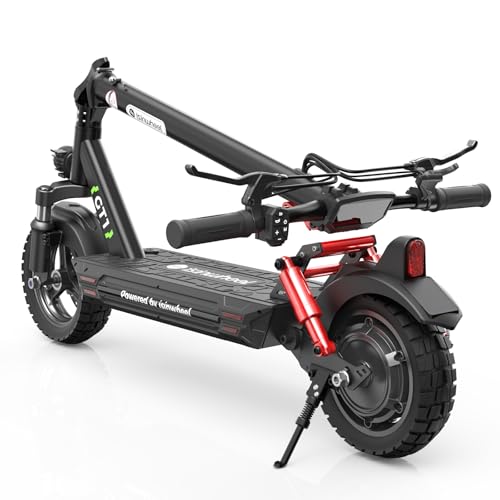

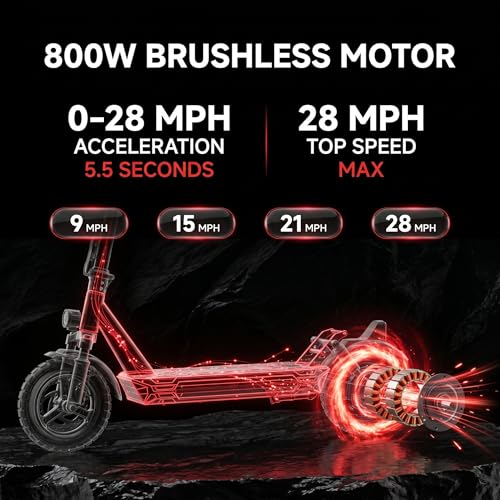
The isinwheel GT1 is a practical option for campers who want more power and off-road capability than a basic commuter scooter provides. Its 800W brushless motor delivers a claimed top speed of 28 mph, while four selectable speed settings allow riders to slow down around crowded campsites or use more power on open roads.
- Camping-Friendly Tires: The 10-inch pneumatic tires offer better grip and cushioning on firm gravel and dirt roads.
- Useful Power and Range: An 800W motor and up to 28 miles of claimed range suit campground errands and recreational rides.
- Enhanced Visibility: Turn signals and multiple lights help riders remain visible around campground roads.
- Not for Technical Trails: The scooter is better suited to maintained surfaces than mud, deep gravel, roots, or rocky trails.
- Range Depends on Conditions: Off-road riding and hills can significantly reduce the maximum advertised range.
- Requires Tire Care: Pneumatic tires need regular pressure checks and can be punctured by sharp debris.
The isinwheel GT1 is a budget-conscious choice for campers who want off-road-style tires, dual suspension, and useful riding power without paying for a premium adventure scooter. It features an 800-watt brushless motor, an approximate top speed of 28 mph, and up to 28 miles of claimed range.
The GT1 is equipped with 10-inch pneumatic off-road tires and front and rear shock absorbers intended to improve comfort and stability on rougher surfaces. That can make it suitable for campground loops, packed dirt, maintained gravel roads, and moderately uneven pavement.
Its four adjustable speed settings allow riders to select a suitable pace for crowded campgrounds or more open access roads. The scooter also supports riders weighing up to 330 pounds and includes headlights, turn signals, taillights, ambient lights, app connectivity, and a dual braking system.
Why it works for camping:
- 10-inch pneumatic off-road tires
- Front and rear shock absorbers
- Powerful 800-watt motor
- Four adjustable speed settings
- Folding design for vehicle storage
- Lights and turn signals for better visibility
- App-based battery and riding controls
- Higher load capacity than many commuter scooters
Important drawback: At 47 pounds, the GT1 may be difficult for some campers to lift repeatedly. Its advertised 28-mile range may also decrease on hills, loose surfaces, or when carrying heavier riders and gear.
Best for: Budget-conscious campers who want a capable scooter for campground loops, packed dirt, and gravel access roads. campground loops, packed dirt, and gravel access roads.
3. NIU KQi3 Max: Best for Paved Campgrounds and Portability


The NIU KQi3 Pro Electric Scooter is designed for urban commuters who want a reliable, smooth, and efficient ride. With a 31-mile range and a top speed of 20 mph, this scooter balances performance with practicality. Its foldable frame makes it easy to carry and store, while the pneumatic tires ensure a comfortable ride on various terrains. Whether you're heading to work or cruising around town, the KQi3 Pro delivers a dependable and enjoyable experience.
- Long Range: Travels up to 31 miles on a single charge, ideal for daily commuting.
- Smooth Ride: Pneumatic tires and ergonomic grips provide comfort on different surfaces.
- Portable Design: Foldable frame allows for easy storage and transport.
- Limited Speed: Maxes out at 20 mph, which may feel slow for some riders.
- Fixed Handlebar: Lacks height adjustability for personalized comfort.
- Mixed Reviews: Some users report durability concerns over time.
Not every camping trip requires an off-road model. The NIU KQi3 Max is a practical alternative for paved campgrounds, RV parks, resort-style camping facilities, and smooth hard-packed roads.
Depending on the current listing and test conditions, the KQi3 Max is advertised with a top speed of up to approximately 23.6 mph and a maximum range in the upper-30-mile range. Its self-healing pneumatic tires can provide better comfort and grip than small solid tires, although the model lacks the extensive suspension found on the Segway ZT3 Pro.
The KQi3 Max is generally more manageable than a heavy off-road scooter. It still is not ultralight, but its lower weight and slimmer frame can make it easier to store in an SUV, van, or RV compartment.
Why it works for camping:
- Suitable for paved campground loops
- Pneumatic tires improve comfort and traction
- Folding frame
- Strong braking system
- Broad standing deck
- Easier to transport than many full off-road scooters
- Useful for both camping trips and everyday commuting
Important drawback: Without full suspension, it is not the best option for washboard gravel, rocky roads, potholes, or repeated off-pavement riding.
Best for: Campers who primarily stay at developed campgrounds, paved RV parks, and recreation areas with smooth internal roads.
4. Gotrax A5: Best Seated Scooter for Campground Errands
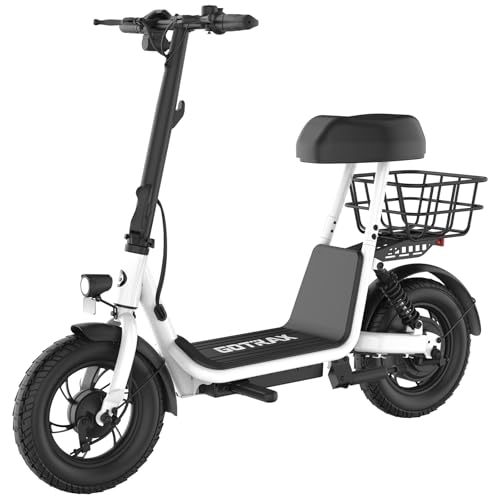


The Gotrax A5 is a comfortable seated electric scooter designed for short commutes, neighborhood trips, and everyday errands. Its 400W motor, with up to 550W peak power, delivers a claimed top speed of 15.5 mph and a maximum range of approximately 15.5 to 16 miles per charge.
- Comfortable Ride: A cushioned seat, 12-inch pneumatic tires, and dual rear suspension help absorb bumps.
- Useful Cargo Space: The rear basket and handlebar hook provide room for groceries and personal items.
- Simple Controls: The twist throttle and LED battery display are straightforward for new riders.
- Limited Range: The claimed 15.5- to 16-mile range is shorter than many standing commuter scooters.
- Heavy Frame: At 50.7 pounds, the scooter may be difficult to lift into a vehicle.
- Lower Weight Limit: Its 220-pound capacity may not suit larger riders or riders carrying substantial cargo.
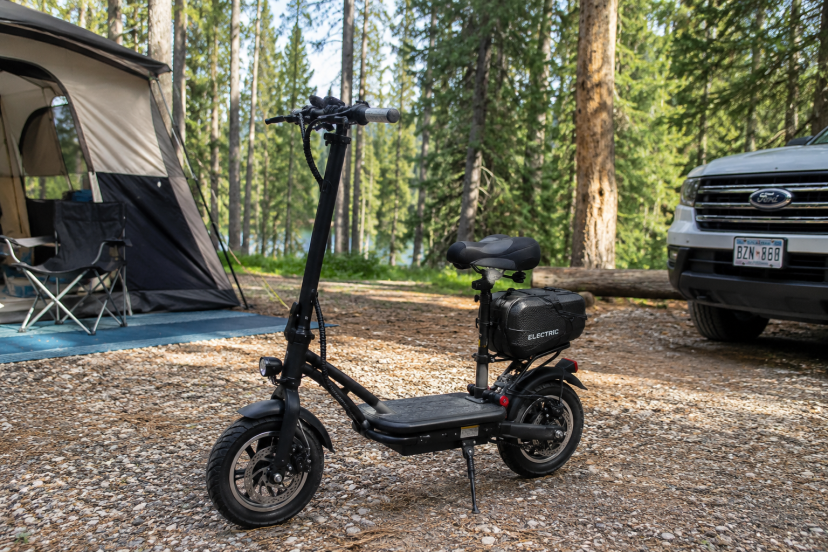
The Gotrax A5 takes a comfort-focused approach. Instead of prioritizing high speed or aggressive off-road performance, it combines a cushioned seat, 12-inch pneumatic tires, dual rear suspension, and a rear cargo basket. This setup can be useful for relaxed campground errands, especially when carrying groceries, towels, picnic supplies, or other small essentials.
Its larger air-filled tires can roll over cracks and minor surface irregularities more smoothly than the smaller wheels found on many compact commuter scooters. The wide foot platform and seated riding position may also suit campers who prefer not to stand throughout the ride.
Powered by a 400-watt motor with up to 550 watts of peak output, the A5 reaches a claimed top speed of 15.5 mph and offers approximately 15.5 to 16 miles of advertised range. It is designed for pavement, compacted roads, and firm, well-maintained campground surfaces rather than steep hills or technical trails.
The rear basket can carry more than 40 pounds, while the handlebar hook can hold up to 11 pounds. Cargo should remain within the scooter’s stated limits and be secured so it cannot shift, interfere with steering, or contact the wheels.
Why it works for camping:
- Comfortable seated riding position
- Large 12-inch pneumatic tires
- Dual rear shock absorbers
- Rear cargo basket for camping supplies
- Handlebar hook for light bags
- Wide foot platform
- Foldable handlebar for storage
- Moderate speed for relaxed campground travel
Important drawback: At approximately 50.7 pounds, the A5 is relatively heavy and bulky to load into a vehicle. Its 220-pound rider limit and shorter advertised range may also be restrictive for some campers.
Best for: RV resorts, large paved campgrounds, campers who prefer seated riding, and anyone who wants a basket for light cargo and short campground errands.
Is an Electric Scooter Good for Camping?
An electric scooter can be a useful camping vehicle when the environment matches its capabilities. It is particularly convenient at developed campgrounds with paved loops, compacted gravel roads, marked bicycle routes, and relatively short distances between facilities.
Common camping uses include:
- Traveling between a campsite and the restroom
- Riding to a camp store or visitor center
- Moving around a large RV resort
- Reaching a nearby fishing access point
- Visiting friends at another campsite
- Carrying small items in a backpack or approved basket
- Exploring paved roads without moving a truck or motorhome
Scooters are less suitable for undeveloped backcountry travel. Their relatively small wheels can sink into sand, slide on loose gravel, or stop abruptly against roots and embedded rocks. Limited ground clearance also makes the deck and battery enclosure vulnerable to impacts.
A scooter may be marketed as “off-road” because it has knobby tires, suspension, or a high-output motor. That does not automatically mean it is safe on hiking trails, mountain-bike routes, wilderness paths, or unmaintained forest roads. In many places, using a motorized device on such trails may also be prohibited.
The safest approach is to regard an electric scooter as a campground transportation tool rather than a substitute for a dirt bike or all-terrain vehicle.
How to Choose an Electric Scooter for Camping
Match the Tires to the Surface
Tires have a major influence on safety and comfort. Small solid tires are resistant to punctures but transmit more vibration and can lose grip on loose surfaces. Pneumatic tires provide better cushioning and traction, although they require pressure checks and can be punctured.
For camping, 10-inch tires are a useful minimum when regularly riding on imperfect surfaces. Eleven-inch tires offer more ability to roll over small stones, cracks, and shallow ruts. Wider or knobby tires can help on firm dirt, but they cannot make a scooter suitable for deep sand or mud.
Check tire pressure before every trip. Pressure that is too low can reduce range, damage the tire or rim, and make handling unpredictable.
Look for Effective Suspension
Suspension improves comfort and helps the tires remain in contact with uneven ground. A front-only system may be adequate for cracked pavement, while front and rear suspension is preferable for gravel and washboard roads.
Suspension does not remove the danger posed by large rocks, roots, potholes, or abrupt ledges. The rider still needs to slow down, keep both hands on the handlebars, and avoid surfaces beyond the scooter’s design.
Buy for Realistic Range
An advertised range of 30 or 40 miles does not mean every rider will achieve it. Range is affected by:
- Rider and cargo weight
- Speed
- Inclines
- Tire pressure
- Wind
- Temperature
- Surface resistance
- Frequent starts
- Motor mode
- Battery condition
Loose dirt and steep roads demand more energy than smooth, level pavement. For camping, choose a scooter whose advertised range is comfortably greater than the distance you expect to travel.
A conservative strategy is to plan around roughly half to two-thirds of the maximum advertised figure until you have tested the scooter in comparable conditions. Always preserve enough battery to return to camp.
Consider Motor Power and Hills
A stronger motor helps when climbing hills and moving over loose ground, but wattage alone does not determine climbing ability. Controller programming, battery voltage, rider weight, tire size, traction, and temperature also matter.
A 350- to 500-watt commuter motor may be sufficient for flat paved campgrounds. Hilly locations may call for a higher-output motor, but riders should not assume that a powerful scooter can safely climb every slope. If the tires begin to spin or the scooter slows dramatically, dismount and walk.
Check Weight Before Ordering
Adventure-oriented scooters can weigh more than 60 pounds. That weight may not matter while riding, but it becomes important when loading the scooter into a vehicle.
Before buying, consider:
- The height of the vehicle’s cargo floor
- Whether one person can lift the scooter
- The size of the folded scooter
- Available RV compartment dimensions
- Whether the handlebars fold
- How the scooter will be secured during travel
A smaller scooter that you can transport safely may be more useful than a powerful model that is difficult to load.
Review Water Resistance Carefully
A water-resistance rating describes limited test conditions. It is not permission to submerge the scooter, ride through streams, leave it exposed during storms, or charge it while wet.
Store the scooter beneath a rigid shelter or inside a dry vehicle. Avoid wrapping a wet scooter tightly in a waterproof cover, as trapped moisture may promote corrosion. Allow it to dry before charging.
Can You Ride an Electric Scooter in a National Park or Campground?
Rules vary among federal, state, county, municipal, and privately operated campgrounds. Do not assume that a rule allowing bicycles or e-bikes also permits electric scooters.
The National Park Service’s published e-bike regulations specifically address qualifying electric bicycles and state that those rules do not apply to electric scooters, mopeds, or electric motorcycles. Powered scooters may therefore be governed by different motorized-vehicle rules, individual park restrictions, road regulations, or superintendent policies.
Before traveling, check:
- The campground’s official website
- The park’s compendium or local regulations
- Posted signs at entrances and trailheads
- State and municipal scooter laws
- Guidance from a ranger or campground manager
Even where scooters are allowed, their use may be limited to public roads, paved paths, parking areas, or designated transportation routes. Never ride through closed areas, designated wilderness, pedestrian-only paths, or protected natural terrain.
Charging an Electric Scooter While Camping
Charging deserves special attention because lithium-ion battery failures can cause intense fires.
Use only the charger supplied or specifically approved for the model. Connect it to a stable, appropriate power source, and remain present while charging. Do not charge inside a tent, under bedding, beside fuel, near a campfire, or in an area where the scooter blocks an exit.
At an RV electrical pedestal, confirm that campground policy allows scooter charging and that the outlet is properly protected. Do not create improvised charging systems with undersized extension cords or unverified adapters.
Portable power stations may charge some scooters, but the power station must provide sufficient continuous output and usable battery capacity. The scooter charger’s input rating should be checked before connection. Repeatedly converting battery power from a portable station into AC and then back into DC also creates efficiency losses.
A vehicle inverter should only be used when its manufacturer permits the load and the installation is properly rated. Never run a vehicle in an enclosed or poorly ventilated area to charge the scooter.
Camping Safety Checklist
Before each ride:
- Inspect the tires, wheels, brakes, stem, folding mechanism, throttle, lights, cables, and frame.
- Test both brakes at low speed.
- Wear a properly fitted helmet.
- Use eye protection on dusty roads.
- Keep both hands on the handlebars.
- Carry gear in a backpack or secured basket, not from the handlebars.
- Turn on lights in low visibility.
- Ride at walking speed around crowded campsites.
- Watch for children, pets, tent lines, vehicles, potholes, and loose gravel.
- Never carry a passenger.
- Do not ride after consuming alcohol or impairing substances.
- Tell another camper where you are going when riding beyond the immediate loop.
- Carry a phone, basic repair kit, compact pump, and suitable lock.
Wildlife also requires caution. Do not chase, approach, or attempt to pass closely by animals. Stop at a safe distance and follow the instructions of park personnel.
The Final Verdict
The best electric scooter for camping depends on how and where you camp.
The Segway ZT3 Pro is the most complete choice for maintained gravel, hills, and rough campground roads. The isinwheel GT1 offers similar adventure-oriented appeal at a potentially more accessible price. The NIU KQi3 Max is a better fit for paved campgrounds and users who value easier storage. The GOTRAX A5 stands out for low-speed seated errands and light cargo carrying.
Whichever model you choose, avoid buying solely on top speed. Tire size, suspension, braking, weight, range, charging safety, and legal access matter far more during a camping trip.
An electric scooter can make a large campground easier to explore, but it should be used as a practical transportation tool, not as an unrestricted off-road vehicle.
Frequently Asked Questions
1. What type of electric scooter is best for camping?
For mixed campground surfaces, look for 10- or 11-inch pneumatic tires, front and rear suspension, dependable mechanical brakes, a folding frame, sufficient ground clearance, and a battery with more range than your planned journey requires. Paved RV resorts may only require a conventional commuter scooter.
2. Can an electric scooter travel on gravel?
Some scooters can handle firm, maintained gravel at reduced speeds. Larger pneumatic tires and suspension improve control, but loose, deep, or sharply graded gravel can cause loss of traction. Avoid sudden steering, acceleration, or braking, and walk the scooter when the surface becomes unstable.
3. How much electric scooter range is needed for camping?
Add the total distance of every planned round trip, then include a substantial reserve. A scooter advertising 30 miles may provide much less under camping conditions involving hills, loose roads, wind, cold temperatures, cargo, or high speeds. Test the scooter near home before relying on it at a remote campsite.
4. Can I leave an electric scooter outside at a campsite?
It is better to store it in a dry, secure vehicle or enclosed RV compartment. Water resistance does not protect against prolonged rain, flooding, theft, animal interference, or overnight condensation. Let a wet scooter dry completely before charging it.
5. Can a portable power station charge an electric scooter?
Potentially, provided the power station supports the charger’s input requirements and has enough usable capacity. Compare the scooter battery’s watt-hours, charger wattage, power station output, and conversion losses. Use approved equipment, charge only while present, and keep the battery and charger away from tents and flammable materials.