Electric Scooter Wattage Explained
*We may earn a commission for purchases made using our links. Please see our disclosure to learn more.
Electric scooter wattage is one of the first specs people notice when comparing models, but it is also one of the easiest to misunderstand. A scooter may advertise a 350W motor, a 500W motor, dual 1000W motors, or a peak power number that sounds much higher than the scooter’s everyday performance. For shoppers, that can make it hard to know what wattage actually means in real-world riding.
In simple terms, wattage tells you how much electrical power the motor can use to help move the scooter. A higher wattage motor can usually accelerate faster, carry more weight, and handle hills better than a lower wattage motor. However, wattage is not the only factor that determines performance. Battery voltage, controller output, rider weight, tire type, terrain, scooter weight, and motor design all affect how powerful a scooter feels on the road.
That is why two scooters with the same wattage rating can perform very differently. A well-designed 500W commuter scooter may feel smoother and more capable than a poorly optimized scooter with a higher advertised rating. Likewise, a scooter with a big peak wattage number may not deliver that power continuously.
Understanding electric scooter wattage helps you choose a scooter that fits your actual riding needs instead of simply picking the biggest number on the spec sheet.
“A watt is a measure of power equivalent to joules per second or energy per second.”
Source: Rider Guide
Key Takeaways
- Electric scooter wattage measures motor power, but it does not tell the full story by itself.
- Nominal wattage, also called continuous wattage, is usually more useful than peak wattage because it reflects the motor’s sustained output during normal riding.
- Peak wattage describes short bursts of extra power, often used during acceleration, hill climbing, or heavier load conditions.
- A 250W to 350W scooter may work for flat, short trips, while 500W to 750W is usually more practical for adult commuting.
- Heavier riders, hilly routes, faster acceleration, and rougher roads usually require higher wattage.
- Battery capacity, voltage, controller tuning, tire size, suspension, and scooter weight can all change how a wattage rating feels in real life.
- More wattage often means more power, but it can also mean higher cost, heavier scooter weight, faster battery drain, and reduced portability.
What Does Wattage Mean on an Electric Scooter?
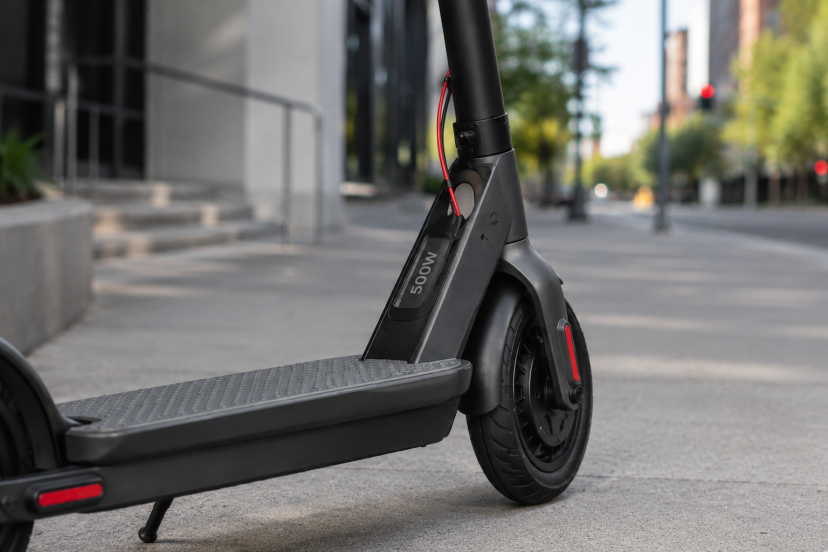
Wattage is a measurement of power. On an electric scooter, it usually refers to the power rating of the motor. The motor converts electrical energy from the battery into mechanical energy that turns the wheel and moves the scooter forward.
Most modern electric scooters use brushless DC hub motors. These motors are often built directly into the front wheel, rear wheel, or both wheels. Because the motor sits inside the wheel hub, the scooter does not need a traditional chain or belt drive. This helps keep many electric scooters compact, quiet, and relatively low-maintenance.
When you see a scooter listed as 350W, 500W, or 1000W, that number is usually describing the motor’s rated power. In general, a higher wattage motor can consume more electrical energy in a short period, which can translate into stronger acceleration, better hill climbing, and improved performance under load. Rider Guide explains that motor wattage refers to how much power the motor is capable of consuming, and that higher motor watt ratings generally help with acceleration, rider weight, and steep hills.
However, wattage should not be treated like a simple “higher is always better” score. A scooter’s performance depends on how the motor, battery, controller, and frame are designed to work together.
Nominal Wattage vs. Peak Wattage
One of the most important things to understand is the difference between nominal wattage and peak wattage.
Nominal wattage is the motor’s sustained power rating. It tells you how much power the motor is designed to deliver under normal operating conditions. This is often the more useful number when comparing scooters because it reflects everyday riding performance.
Peak wattage is the maximum power the motor can deliver for a short period. This may happen when accelerating from a stop, climbing a hill, or carrying a heavier load. Peak wattage can sound impressive, but it does not always represent what the scooter can maintain continuously.
For example, a scooter may have a 500W nominal motor and a 900W peak output. That does not mean it rides like a 900W scooter all the time. It means the motor and controller may briefly draw or deliver higher power when needed.
Several scooter brands and technical guides describe this distinction in similar terms. Teverun explains nominal wattage as continuous power output under normal conditions, while peak wattage refers to the maximum output used for short bursts such as acceleration or hill climbing. Apollo Scooters also describes continuous power as sustained output and peak power as the maximum output the motor can deliver temporarily.
When shopping, pay closer attention to nominal wattage than peak wattage. Peak wattage is useful, but it can be used in marketing to make a scooter sound more powerful than it feels in daily use.
Common Electric Scooter Wattage Ranges
Electric scooters come in a wide range of power levels. Here is a practical breakdown of what different wattage ranges usually mean.
250W Electric Scooters
A 250W electric scooter is usually an entry-level model. It may work for lightweight riders, flat roads, short trips, and lower-speed riding. These scooters are often affordable and portable, but they may struggle with hills, heavier riders, and rougher surfaces.
A 250W scooter can be useful for casual neighborhood rides, campus paths, or last-mile transportation where the route is mostly flat. However, many adult riders may find this wattage underpowered for daily commuting.
350W Electric Scooters
A 350W scooter is a common step up from entry-level models. It can usually handle basic commuting better than a 250W scooter, especially on flat city streets. Acceleration may feel more confident, and the scooter may support a wider range of rider weights.
For many beginners, 350W is a reasonable starting point. It is still usually light enough to remain portable, but it offers more practical power than very low-wattage models.
However, 350W may still feel limited on steeper hills or longer routes. If your commute includes inclines, frequent stops, or heavier loads, you may want to consider 500W or higher.
500W Electric Scooters
A 500W electric scooter is often the sweet spot for adult commuting. It usually provides stronger acceleration, better hill performance, and more confidence in stop-and-go city riding.
For many riders in the US, 500W is a practical minimum for a daily commuter scooter. It gives enough power for most urban routes without making the scooter too heavy or expensive. It is also a good range for riders who want something more capable than a basic recreational scooter but do not need a high-performance model.
A 500W scooter may still vary widely depending on build quality, battery size, and controller settings. A high-quality 500W scooter can feel much better than a budget scooter with the same motor rating.
750W Electric Scooters
A 750W scooter provides stronger performance for heavier riders, hillier areas, and longer commutes. This wattage range often feels more responsive, especially when accelerating from a stop or riding up moderate inclines.
If you live in a city with hills, carry a backpack, or want a scooter that does not feel strained during daily use, 750W can be a strong choice. The tradeoff is that scooters in this range may be heavier, more expensive, and less compact.
1000W and Higher Electric Scooters
Scooters with 1000W motors or higher are usually performance-oriented models. They are built for stronger acceleration, steeper hills, heavier riders, and higher top speeds. Some scooters use dual motors, such as two 1000W motors, for even more power and traction.
These scooters can be fun and capable, but they are not always the best choice for every rider. They are often heavier, harder to carry, more expensive, and more demanding on battery life. They may also exceed local speed or power limits depending on where you ride.
High-wattage scooters are best for experienced riders who need extra capability and understand the safety responsibilities that come with more power.
How Wattage Affects Acceleration
One of the most noticeable effects of wattage is acceleration. Higher wattage scooters usually get moving faster from a stop. This can make a scooter feel more responsive in city traffic, especially at intersections or when starting on a slight incline.
Acceleration is especially important for commuters. A scooter that takes too long to reach riding speed can feel frustrating or less stable in traffic-heavy areas. A stronger motor can help the scooter respond more quickly when you press the throttle.
However, acceleration is not only about wattage. Controller tuning plays a major role. The controller regulates how much power flows from the battery to the motor. Some scooters are tuned for smooth, gradual acceleration, while others are tuned for a more aggressive launch.
This is why two 500W scooters can feel different. One may feel gentle and beginner-friendly, while another may feel punchier and more responsive.
How Wattage Affects Hill Climbing
Hill climbing is one of the biggest reasons to choose a higher-wattage scooter. Climbing hills requires the motor to work harder against gravity. A lower-wattage scooter may slow down significantly, overheat, or fail to climb steeper inclines.
For flat areas, 250W to 350W may be enough. For moderate hills, 500W is often more realistic. For steeper hills, heavier riders, or longer inclines, 750W or more may be necessary.
That said, hill climbing also depends on torque, battery voltage, motor design, and scooter weight. Wattage gives you a helpful clue, but it does not tell the whole story. Torque is especially important because it describes rotational force, which affects how strongly the motor can turn the wheel under load.
If you live in a hilly part of the US, do not shop by wattage alone. Look for real-world hill climb reviews, rider weight tests, and incline ratings. A scooter that performs well on paper may still struggle if its battery or controller cannot support sustained climbing.
How Wattage Affects Top Speed
Higher wattage can contribute to higher top speed, but the relationship is not always direct. Many scooters are electronically limited to a certain speed for safety, legal, or battery reasons.
For example, two scooters may both have 500W motors, but one may be limited to 20 mph while another may reach 25 mph. A higher-wattage scooter may have the power to go faster, but speed can still be controlled by firmware, local regulations, battery voltage, and motor design.
In the US, electric scooter laws vary by state and city. Some areas limit where scooters can be ridden, how fast they can go, or whether they are allowed on sidewalks. Because of this, the fastest scooter is not always the most practical scooter.
For commuting, many riders are better served by a scooter that can comfortably hold a safe, legal speed rather than one that simply advertises the highest maximum speed.
How Wattage Affects Range
A common misconception is that higher wattage automatically means longer range. In reality, higher wattage often means the scooter can use more energy, which may drain the battery faster if you ride aggressively.
Range depends more directly on battery capacity, which is usually measured in watt-hours, or Wh. A scooter with a larger battery can store more energy. Motor wattage tells you how much power the motor can use, while battery watt-hours tell you how much energy is available.
For example, a powerful 1000W scooter with a small battery may have less range than a 500W scooter with a larger battery. Riding style also matters. Frequent acceleration, high speeds, hills, heavy loads, cold weather, and underinflated tires can all reduce range.
This is why real-world range is often lower than advertised range. Many manufacturer range estimates are based on ideal conditions, such as a lightweight rider, flat terrain, low speed, and mild weather.
Wattage vs. Battery Voltage
Wattage and voltage are related, but they are not the same thing.
Voltage describes the electrical pressure of the battery system. Common electric scooter battery voltages include 36V, 48V, 52V, and 60V. Higher-voltage systems can often deliver power more efficiently and support stronger performance.
Wattage is calculated from voltage and current. In simplified terms:
Watts = Volts × Amps
This means a scooter’s power depends not only on the motor rating but also on how much current the battery and controller can deliver. A scooter with a stronger controller and higher-voltage battery may feel more powerful than another scooter with the same nominal motor wattage.
The US Department of Energy’s Alternative Fuels Data Center explains that all-electric vehicles use traction battery packs to power electric motors. Although the source is discussing larger electric vehicles rather than scooters, the same basic relationship applies: the battery supplies electrical energy, and the motor converts it into motion.
For shoppers, this means you should compare the full electrical system, not just the motor wattage.
Single Motor vs. Dual Motor Wattage
Some scooters have one motor, while others have two. Dual-motor scooters usually place one motor in the front wheel and one in the rear wheel.
A single 500W motor scooter has one powered wheel. A dual 500W scooter has two 500W motors, often described as 1000W total nominal power. Dual motors can improve acceleration, hill climbing, and traction because power is distributed across both wheels.
However, dual motors also add weight, cost, and battery demand. They are usually found on performance scooters rather than lightweight commuter models.
For most city commuters, a single 500W or 750W motor may be enough. For steep hills, heavier riders, or higher-performance riding, dual motors can make a noticeable difference.
Does Higher Wattage Mean a Better Scooter?
Not always. Higher wattage usually means more potential power, but it does not automatically mean better quality.
A good electric scooter also needs:
- A reliable battery
- Strong brakes
- Stable tires
- Quality suspension or ride comfort
- A sturdy frame
- Good water resistance
- Practical weight and folding design
- Safe lighting
- Clear controls
- Replacement parts and support
A high-wattage scooter with poor brakes or weak tires is not a good choice. More power should be matched with better safety features. As wattage increases, braking performance, frame strength, and stability become even more important.
For many riders, the best scooter is not the most powerful scooter. It is the scooter with the right balance of power, range, portability, safety, comfort, and price.
Recommended Wattage by Rider Type
For casual riders on flat roads, 250W to 350W may be enough. This works best for short trips, light use, and lower speeds.
For most adult commuters, 500W is a better target. It gives more confidence for daily riding, mild hills, and stop-and-go conditions.
For heavier riders or hilly routes, 750W to 1000W may be more appropriate. This range helps reduce strain on the motor and improves climbing ability.
For performance riders, dual motors or 1000W+ systems may be worth considering. These scooters are best for people who prioritize acceleration, speed, and hill climbing over portability.
For college students or apartment dwellers, wattage should be balanced with weight. A 1000W scooter may sound appealing, but it may be inconvenient if you need to carry it upstairs or lift it into a car trunk.
What Wattage Is Best for Commuting?
For commuting in the US, 500W is often the most practical starting point for adults. It provides enough power for everyday use while keeping the scooter reasonably portable and efficient.
If your commute is mostly flat and short, a 350W scooter may work. If your route includes hills, rough pavement, or longer distances, a 500W to 750W scooter is usually a safer choice.
Commuters should also pay close attention to battery capacity. A powerful motor is not helpful if the battery cannot support your full round trip. As a general rule, choose a scooter with more advertised range than you think you need because real-world range often drops under normal riding conditions.
What Wattage Is Best for Heavy Adults?
Heavier riders usually need more wattage because the motor has to work harder to accelerate, maintain speed, and climb hills. A 250W or 350W scooter may feel sluggish or may not perform well near its maximum load rating.
For heavier adults, 500W should usually be considered the minimum starting point. A 750W or 1000W scooter may be better for improved comfort, hill climbing, and durability.
Weight capacity is also important. Do not rely on wattage alone. Check the manufacturer’s maximum rider weight, frame construction, deck size, tire size, and braking system.
What Wattage Is Best for Hills?
For gentle hills, 350W may be acceptable for lighter riders. For moderate hills, 500W is more practical. For steeper hills or heavier riders, 750W to 1000W or dual motors may be necessary.
When comparing scooters for hills, look for:
- Nominal motor wattage
- Peak wattage
- Torque information, if available
- Battery voltage
- Controller output
- Incline rating
- Real-world hill climbing reviews
- Rider weight used during testing
Incline ratings can be optimistic, so real-world reviews are especially useful.
Why Some Scooters Feel More Powerful Than Their Wattage
A scooter’s wattage rating is only one part of its performance. Some scooters feel stronger than expected because they have efficient motors, better controllers, higher-voltage batteries, lighter frames, or better tire grip.
Other scooters feel weaker than expected because they are heavy, poorly tuned, underpowered by the battery, or limited by firmware.
Tire type also matters. Pneumatic tires can improve traction and comfort, while solid tires may reduce maintenance but feel harsher. Scooter weight affects acceleration and climbing. A heavy scooter needs more power to feel quick.
This is why spec sheets should be used as a starting point, not the final answer.
Common Mistakes When Comparing Scooter Wattage
One common mistake is comparing peak wattage on one scooter to nominal wattage on another. This can make one scooter look more powerful than it really is. Always check whether the listed number is continuous or peak power.
Another mistake is assuming higher wattage means longer range. A powerful motor can drain the battery faster, especially at high speeds or on hills.
A third mistake is ignoring scooter weight. A 1000W scooter may be powerful, but if it weighs 80 pounds, it may be inconvenient for daily use.
Another mistake is overlooking brakes. As motor power increases, braking quality becomes more important. Disc brakes, hydraulic brakes, electronic braking, and regenerative braking systems can all affect stopping performance.
Finally, many shoppers focus on wattage and ignore local rules. A high-powered scooter may not be legal or practical in every riding environment.
How to Read an Electric Scooter Spec Sheet
When reviewing a scooter spec sheet, look beyond the biggest wattage number. Pay attention to:
- Nominal motor wattage
- Peak motor wattage
- Single or dual motor design
- Battery voltage
- Battery capacity in Wh
- Maximum rider weight
- Claimed range
- Top speed
- Scooter weight
- Tire type and size
- Brake type
- Suspension
- Water-resistance rating
- Incline rating
The most useful comparison combines motor wattage with battery capacity, rider weight support, and real-world testing. If a spec sheet only highlights peak wattage and does not clearly state nominal wattage, compare carefully.
Final Thoughts: Choose the Wattage That Matches Your Ride
Electric scooter wattage is important, but it should not be the only spec you use to choose a scooter. Wattage helps explain how much power a motor can use, which affects acceleration, hill climbing, and performance under load. However, real-world riding depends on the full system: motor, battery, controller, tires, brakes, frame, rider weight, and terrain.
For light, flat, casual riding, 250W to 350W may be enough. For most adult commuters, 500W is a stronger and more practical choice. For hills, heavier riders, and more demanding routes, 750W to 1000W or dual motors may be worth considering.
The best electric scooter is not always the one with the highest wattage. It is the one with enough power for your route, enough battery for your range, enough braking for your speed, and enough comfort for the way you actually ride.
FAQs
1. Is higher wattage better for an electric scooter?
Higher wattage usually means stronger acceleration, better hill climbing, and improved performance for heavier riders. However, it does not automatically mean the scooter is better. A good scooter also needs the right battery capacity, brakes, tires, frame quality, suspension, and overall design. For many riders, a balanced 500W commuter scooter may be more practical than a heavy 1000W performance scooter.
2. How many watts is good for an electric scooter?
For light, flat, casual riding, 250W to 350W may be enough. For most adults using an electric scooter for commuting, 500W is a practical starting point. Riders who deal with hills, heavier loads, or longer routes may want 750W to 1000W or a dual-motor scooter for stronger performance.
3. What is the difference between nominal wattage and peak wattage?
Nominal wattage refers to the motor’s sustained power during normal riding. Peak wattage refers to the maximum power the motor can deliver for short bursts, such as during acceleration or hill climbing. When comparing scooters, nominal wattage is usually the more useful number because it better reflects everyday performance.
4. Does more wattage mean more speed?
More wattage can help a scooter reach higher speeds, but it does not guarantee a higher top speed. Speed also depends on battery voltage, controller settings, rider weight, terrain, tire size, and electronic speed limits. Some scooters have powerful motors but are still capped at a certain speed for safety or legal reasons.
5. Does higher wattage drain the battery faster?
Higher wattage can drain the battery faster, especially if you ride at high speeds, climb hills, accelerate often, or carry heavier loads. Range depends more directly on battery capacity, measured in watt-hours, but a more powerful motor can use that stored energy more quickly under demanding conditions.