Front Wheel vs. Rear Wheel Drive Electric Scooter
*We may earn a commission for purchases made using our links. Please see our disclosure to learn more.
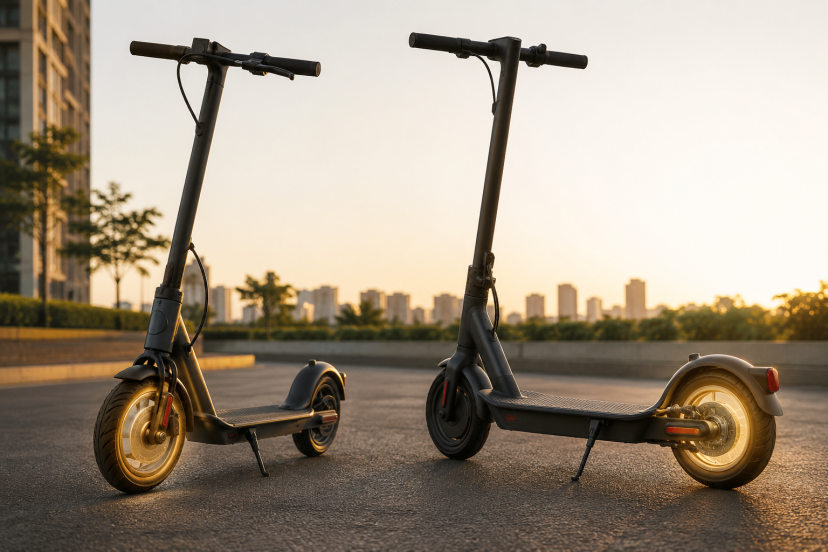
When comparing electric scooters, shoppers usually focus on motor wattage, top speed, range, tire size, and suspension. One specification that receives much less attention is where the motor sends its power.
On a single-motor electric scooter, that usually means choosing between front-wheel drive (FWD) and rear-wheel drive (RWD).
The difference might sound minor, especially when both scooters have similar motor ratings. In practice, motor placement can affect acceleration, traction, hill climbing, steering feel, and how confidently the scooter puts power to the ground.
Front-wheel-drive scooters are common among affordable commuter and beginner models. They can be simple, predictable, and perfectly adequate for flat urban riding. Rear-wheel-drive scooters, meanwhile, tend to feel more planted when accelerating and can make better use of stronger motors, particularly when climbing hills or carrying heavier riders.
That does not mean every rear-wheel-drive scooter is automatically better. A well-designed front-drive scooter can outperform a poorly designed rear-drive model. Motor output, controller tuning, battery voltage, tires, rider weight, suspension, and road conditions all matter.
Understanding the difference helps you choose a scooter based on how and where you actually ride.
Key Takeaways
- Front-wheel drive pulls the scooter forward, while rear-wheel drive pushes it from behind.
- Rear-wheel drive generally provides better traction during acceleration because a rider’s weight naturally shifts toward the rear wheel as the scooter accelerates.
- Front-wheel-drive scooters can work very well for flat, moderate-speed commuting, especially when portability and affordability matter more than maximum performance.
- Rear-wheel drive is usually preferable for hills, stronger acceleration, heavier riders, and higher-powered single-motor scooters.
- Motor location should never be evaluated alone. Motor wattage, battery output, tires, suspension, brakes, controller programming, and scooter geometry can make a larger difference.
- For most riders comparing otherwise similar single-motor scooters, rear-wheel drive has the overall performance advantage, while front-wheel drive remains a practical option for lighter-duty commuting.
4 Electric Scooters That Show the Difference Between FWD and RWD
The following four models illustrate how manufacturers use front and rear motors at different performance levels.
1. Segway E2 Plus II: Front-Wheel Drive for Beginners


The Segway Ninebot E2 Plus II is a foldable electric scooter designed for beginners, teenagers aged 14 and older, and adults with short daily commutes. It reaches a top speed of 15.5 mph and offers a claimed range of up to 16 miles in Eco Mode or 12 miles in Sport Mode.
- Beginner-Friendly Controls: Smooth acceleration and simple controls make the scooter easy to operate.
- Low-Maintenance Tires: Inner-hollow tires absorb some vibration without the risk of punctures.
- Certified Electrical System: UL 2272 and UL 2271 certifications provide added safety assurance.
- Long Charging Time: A full charge takes approximately 7.5 hours.
- Limited Rider Capacity: The 198-pound weight limit is lower than many adult scooters.
- Short Sport Range: The claimed range drops to about 12 miles when using Sport Mode.
Best for: Short trips and first-time riders
The Segway E2 Plus II represents the lighter-duty side of front-wheel-drive scooters.
It uses a 300W nominal motor with up to 500W maximum output and a front-wheel-drive layout. Segway lists a maximum speed around 15.5 mph and markets the model toward commuting, school, and casual riding.
The E2 Plus II is a useful example of where front-wheel drive makes sense. The motor output is moderate, so extreme traction demands are unlikely during ordinary riding.
Its front suspension also helps improve comfort over imperfect urban pavement.
Why choose it: Simple power delivery, beginner-oriented performance, and relatively manageable specifications.
Consider something else if: Your commute includes steep hills, long distances, or you want significantly stronger acceleration.
2. Hiboy S2: Affordable Front-Wheel-Drive Commuter


The Hiboy S2/S2R Plus Electric Scooter is built for commuters who want a reliable and powerful scooter that combines speed, range, and safety. Powered by a 350W motor, it reaches speeds up to 19 mph and offers a 17-mile range on a single charge. Featuring a double braking system with disc brakes and eABS regenerative anti-lock braking, it ensures a smooth and safe ride. The solid rubber tires provide durability and a stable ride, while the Hiboy app allows you to lock your scooter, customize settings, and track your performance. With a portable design and the ability to fold for easy storage, it’s an excellent choice for daily commuting or quick city trips.
- Powerful Performance: 350W motor with 19 mph top speed
- Safety Features: Double braking system with disc and eABS brakes
- App Integration: Control settings and lock the scooter via the Hiboy app
- Weight: At 29.5 lbs, it may be heavy for some users to carry
- Range Limitation: 17 miles may not be enough for very long commutes
- Seat Sold Separately: The extra detachable seat is not included in the base package
Best for: Budget-conscious urban riders
The Hiboy S2 uses a 350W front motor and is rated for speeds up to 19 mph and a claimed maximum range of 17 miles. Hiboy lists a maximum rider capacity of 220 pounds.
Its front-wheel-drive design is paired with rear suspension and solid honeycomb tires.
That makes it primarily a practical short-distance commuter rather than a dedicated hill climber. Independent testing has also found that the S2 loses substantial speed on steeper inclines, reinforcing the importance of considering motor output and hill performance rather than drivetrain alone.
Why choose it: Affordable transportation, low-maintenance tires, and straightforward commuter performance.
Consider something else if: Hills are a major part of your daily route or you need longer range.
3. Segway Max G2: Rear-Wheel Drive for Everyday Commuting


The Segway Ninebot MAX Series Electric Scooter for Adults is one of the top-rated electric scooters with long battery life, offering an impressive up to 50 miles of range on a single charge. Engineered for commuters and long-distance riders, the MAX G2/G3 series combines advanced RideyLONG™ technology, a 551Wh high-capacity battery, and an efficient 1000W motor to deliver extended travel without constant recharging.
- Long Battery Life: Up to 43–50 miles per charge, perfect for long-distance commuting.
- Advanced Ride Comfort: Dual suspension and self-healing tires provide a smooth, stable ride.
- Safety & Control: UL-certified with traction control, dual brakes, turn signals, and Apple Find My support.
- Higher Price Point: Premium features make it more expensive than entry-level scooters.
- Heavier Build: The solid battery and suspension add weight, making it less portable.
- Longer Charge Time: Full recharge takes longer compared to smaller scooters.
Best for: Riders wanting comfort, range, and stronger performance
The Segway Max G2 demonstrates why rear-wheel drive becomes attractive as scooter performance increases.
The U.S. model uses a 450W nominal rear motor with up to 1,000W peak output, according to Segway support. It also has front hydraulic and rear suspension, a maximum rider capacity of 265 pounds, and traction-control technology designed to improve grip on slippery surfaces.
Compared with basic commuter scooters, it is considerably heavier, but that weight comes with a larger battery, suspension, bigger tires, and a more substantial chassis.
Why choose it: Strong all-around commuter performance, rear-driven traction, suspension, and substantial range capability.
Consider something else if: You regularly need to carry your scooter up stairs. At about 53.5 pounds, portability is not its strongest feature.
4. NIU KQi3 Max: Rear-Wheel Drive for Hills and Longer Trips


The NIU KQi3 Pro Electric Scooter is designed for urban commuters who want a reliable, smooth, and efficient ride. With a 31-mile range and a top speed of 20 mph, this scooter balances performance with practicality. Its foldable frame makes it easy to carry and store, while the pneumatic tires ensure a comfortable ride on various terrains. Whether you're heading to work or cruising around town, the KQi3 Pro delivers a dependable and enjoyable experience.
- Long Range: Travels up to 31 miles on a single charge, ideal for daily commuting.
- Smooth Ride: Pneumatic tires and ergonomic grips provide comfort on different surfaces.
- Portable Design: Foldable frame allows for easy storage and transport.
- Limited Speed: Maxes out at 20 mph, which may feel slow for some riders.
- Fixed Handlebar: Lacks height adjustability for personalized comfort.
- Mixed Reviews: Some users report durability concerns over time.
Best for: Strong single-motor performance
The NIU KQi3 Max uses a 450W rear hub motor capable of up to 900W peak output. It is rated for up to 23.6 mph in applicable configurations and a claimed maximum range of 40.4 miles. It also supports riders up to 265 pounds.
Independent testing has highlighted its hill performance, with Rider Guide attributing part of its climbing capability to the rear-wheel-drive motor and available power.
It does not have conventional suspension, so riders should also consider ride comfort if their local pavement is particularly rough.
Why choose it: Strong rear-drive acceleration, good hill performance, substantial battery capacity, and high rider capacity.
Consider something else if: Suspension and easy portability are higher priorities than range and performance.
Front Wheel vs Rear Wheel Drive Electric Scooter Comparison
| Feature | Front-Wheel Drive | Rear-Wheel Drive |
|---|---|---|
| Power delivery | Pulls scooter | Pushes scooter |
| Acceleration traction | Good at moderate power | Generally better |
| Hill performance | Adequate on modest slopes | Usually preferable |
| Front steering feel | Powered wheel also steers | Front wheel dedicated to steering |
| Wheelspin tendency | More likely during hard acceleration | Usually lower during acceleration |
| Beginner commuting | Very suitable | Very suitable with controlled acceleration |
| High-power single motor | Less ideal | Better suited |
| Flat city riding | Excellent | Excellent |
| Heavier riders | Depends strongly on motor | Often preferable |
| Wet or loose surfaces | Requires gentle throttle | Usually better traction, but still requires caution |
| Typical use | Budget and basic commuters | Midrange and performance commuters |
What Is a Front-Wheel-Drive Electric Scooter?
A front-wheel-drive electric scooter places its drive motor in the front wheel. When you press the throttle, the front motor pulls the scooter forward while the rear wheel follows.
Hub motors make this arrangement relatively straightforward because the motor is integrated directly into the wheel.
Front-wheel drive is especially common on affordable commuter scooters where manufacturers prioritize simplicity, moderate power, low weight, and predictable everyday performance.
The Segway E2 Plus II, for example, uses front-wheel drive with 300W nominal output and up to 500W maximum power. Segway positions it as a beginner-friendly model for shorter commutes and everyday riding.
The Hiboy S2 is another example. It uses a 350W front motor and is designed primarily for affordable urban transportation rather than aggressive performance riding.
Advantages of Front-Wheel Drive
The biggest advantage is simplicity.
For a moderate-powered commuter scooter, front drive can provide smooth acceleration without requiring the heavier components found on performance scooters.
Front-wheel-drive scooters are also commonly found in lower price categories, making them attractive to first-time riders.
Because the rear wheel is not responsible for propulsion, manufacturers can use it for a mechanical brake, suspension components, or other packaging arrangements.
At normal commuting speeds on dry, relatively flat pavement, many riders may barely notice the drive layout.
Disadvantages of Front-Wheel Drive
The main limitation becomes apparent when accelerating aggressively.
As a scooter accelerates, the rider’s mass shifts slightly toward the rear. That increases the load over the rear tire and reduces some of the load over the front.
Since a tire’s ability to transfer motor torque depends partly on how much grip it has against the road, the lightly loaded front wheel can reach its traction limit sooner.
That can result in front-wheel spin, particularly when:
- accelerating hard from a stop
- climbing steep inclines
- riding across loose gravel
- crossing painted road markings
- riding on wet or slippery pavement
- using a higher-powered front motor
With low-powered commuter scooters, this may rarely be noticeable. As motor output increases, however, manufacturers have more reason to move the drive motor to the rear.
What Is a Rear-Wheel-Drive Electric Scooter?
A rear-wheel-drive scooter places the motor in the rear wheel.
Rather than pulling from the front, the powered rear tire pushes the scooter forward.
The Segway Max G2 is a good example. Segway specifically describes the model as rear-wheel drive and pairs the layout with a 450W nominal motor, substantially higher peak output, suspension, and traction-control technology.
The NIU KQi3 Max also uses a rear-mounted 450W hub motor with up to 900W peak output. Current Rider Guide specifications list the motor position as rear-driven.
Advantages of Rear-Wheel Drive
Rear-wheel drive benefits from what happens naturally when you accelerate.
As your body weight shifts backward, additional load is placed over the powered tire. That generally helps the rear wheel maintain grip while transmitting torque.
This is particularly useful when climbing.
The same rearward weight transfer that can reduce front-wheel traction during acceleration can help a rear-driven scooter keep pushing forward.
Rear drive can also separate two important jobs:
- the front wheel primarily handles steering
- the rear wheel delivers propulsion
For some riders, that gives the scooter a more planted and natural feeling when accelerating.
Disadvantages of Rear-Wheel Drive
Rear drive is not automatically perfect.
A powerful rear motor can still overwhelm the tire on loose or wet surfaces. An inexperienced rider can also be surprised by aggressive acceleration if the throttle or controller is tuned sharply.
Rear-mounted motors can also make rear wheel service more complicated because wiring and motor components must be dealt with during repairs.
Most importantly, a weak rear-drive scooter does not automatically beat a powerful and well-tuned front-drive scooter.
Drive layout is only part of the equation.
Which Accelerates Better?
If two scooters have identical motors, batteries, tires, controllers, and rider weight, the rear-wheel-drive model generally has the traction advantage during acceleration.
That is because acceleration transfers load toward the rear wheel.
A front-driven scooter is essentially trying to pull through a tire that becomes slightly less loaded as acceleration increases.
A rear-driven scooter is pushing through a tire that becomes more heavily loaded.
This matters most when motor torque is high enough to challenge available traction.
On a 250W or 300W commuter scooter, the difference may feel minor.
On a 700W, 900W, or 1,000W peak single-motor scooter, motor position can become much more noticeable.
Which Is Better for Hills?
For hills, rear-wheel drive is generally the better layout, but do not choose a scooter based solely on FWD versus RWD.
Hill-climbing ability also depends on:
- nominal and peak motor power
- controller current
- battery voltage
- rider weight
- gradient
- tire grip
- motor efficiency
- starting speed
- battery state of charge
A 300W rear-driven scooter will not necessarily climb better than a 500W front-driven scooter.
However, if two otherwise similar models have comparable power, the rear-driven scooter is usually better positioned to use that power while climbing because rider weight shifts toward the rear.
For anyone living in cities with frequent steep streets, motor output and tested hill performance should be considered alongside drive position.
Which Is Better in Rain?
Rear-wheel drive can have a traction advantage, but neither drivetrain makes an electric scooter inherently safe on wet pavement.
Wet roads reduce tire grip. Painted markings, metal utility covers, leaves, sand, and polished surfaces can become particularly slippery.
Regardless of motor placement:
- Reduce speed.
- Accelerate gradually.
- Increase braking distance.
- Avoid abrupt steering inputs.
- Check the manufacturer’s water-resistance guidance before riding.
An IP rating describes resistance under specific test conditions. It should not be interpreted as permission to ride through deep water or severe weather.
Which Feels Better When Steering?
Front-wheel drive combines steering and propulsion at the same wheel.
On lower-powered models, this typically does not cause a major problem. Manufacturers can tune acceleration smoothly enough that steering remains predictable.
As power increases, however, some riders prefer having the motor behind them.
With rear-wheel drive, the front tire is primarily responsible for steering and maintaining directional control while the rear tire supplies propulsion.
This separation can make a stronger scooter feel more balanced under throttle.
Again, scooter geometry matters. Handlebar width, steering angle, wheel size, tire profile, suspension, deck position, and rider stance all affect handling.
Is Front-Wheel Drive Better for Beginners?
Not necessarily, but many beginner scooters happen to use front-wheel drive.
What matters more for a new rider is predictable acceleration.
A mild 300W front-drive commuter may feel much easier to learn on than a powerful rear-drive scooter with an aggressive controller.
Beginner-friendly features to prioritize include:
- smooth throttle response
- lower-speed riding modes
- effective brakes
- wide handlebars
- stable tires
- manageable scooter weight
- good lighting
- appropriate rider capacity
Drive position should be treated as one part of the buying decision rather than a substitute for these fundamentals.
What About Dual-Motor Electric Scooters?
Dual-motor scooters change the equation because they power both wheels.
When both front and rear wheels provide propulsion, the scooter can distribute available power across two contact patches.
This can provide much stronger acceleration and climbing performance than a comparable single-motor machine.
However, dual motors also usually bring:
- higher cost
- increased weight
- greater energy consumption
- stronger acceleration
- more complex controls
- potentially greater maintenance requirements
Most everyday commuters do not need dual motors.
For flat or moderately hilly urban routes, a good rear-wheel-drive single-motor scooter can offer an excellent balance of performance, range, weight, and efficiency.
Front Wheel vs Rear Wheel Drive: Which Should You Choose?
Choose front-wheel drive if your priorities are:
- affordable commuting
- relatively flat terrain
- moderate speeds
- shorter daily trips
- simple beginner-friendly transportation
Choose rear-wheel drive if your priorities are:
- stronger acceleration
- better traction under power
- frequent hills
- carrying a heavier rider
- higher-powered single-motor performance
- a more planted feeling during acceleration
For most riders comparing two scooters with otherwise similar specifications, rear-wheel drive is the stronger overall choice.
The advantage becomes more significant as motor power, hills, rider weight, and acceleration demands increase.
But drivetrain should never outweigh the whole scooter.
A reliable 350W front-drive model with good brakes and sensible controller tuning may be a much better purchase than a poorly designed 500W rear-drive model.
Evaluate the complete package.
Final Verdict
The front wheel vs rear wheel drive electric scooter debate is ultimately about how efficiently a scooter can turn motor torque into forward motion.
Front-wheel drive works well for lightweight, lower-powered commuter scooters. It is simple, practical, and more than capable for many short trips across relatively flat streets.
Rear-wheel drive becomes increasingly advantageous as performance demands rise. Because rider weight shifts toward the rear during acceleration, the driven tire can maintain better traction, particularly when starting quickly or climbing.
That makes rear drive the preferable choice for many midrange and high-performance single-motor scooters.
Still, motor location is only one specification. Before buying, compare power, battery capacity, tires, brakes, suspension, weight, rider capacity, range, and actual test results.
The best drivetrain is the one attached to a scooter that matches your route, terrain, rider weight, and everyday transportation needs.
Frequently Asked Questions
1. Is rear-wheel drive better than front-wheel drive on an electric scooter?
Rear-wheel drive is generally better for traction during acceleration because rider weight shifts toward the rear wheel. It can be particularly useful for hills and higher-powered scooters. Front-wheel drive remains perfectly suitable for many low- to moderate-powered commuter models.
2. Is front-wheel drive safe on an electric scooter?
Yes. Front-wheel-drive electric scooters can be safe when ridden within their intended limits. Riders should accelerate smoothly and use extra caution on wet pavement, gravel, painted surfaces, and other conditions where the front tire could lose traction.
3. Which electric scooter drive is better for hills?
Rear-wheel drive generally has an advantage on hills because more rider weight is transferred over the driven wheel. However, motor power, controller output, battery voltage, rider weight, and hill gradient are often more important than drivetrain position by itself.
4. Does rear-wheel drive make an electric scooter faster?
Not automatically. Top speed is primarily determined by the motor, controller, battery voltage, firmware, wheel size, load, and other design factors. Rear-wheel drive can help a scooter apply available torque more effectively, but it does not inherently create a higher top speed.
5. Is a dual-motor scooter better than rear-wheel drive?
Dual motors can provide substantially greater acceleration and hill-climbing capability because both wheels deliver power. However, dual-motor scooters are typically heavier, more expensive, and consume more energy. For ordinary commuting, a good single-motor rear-wheel-drive scooter is often the more practical option.