Can Two People Ride an Electric Scooter?

*We may earn a commission for purchases made using our links. Please see our disclosure to learn more.
Electric scooters have become a popular mode of transportation in urban areas, offering convenience and eco-friendly mobility. As their popularity grows, a common question arises among users: can two people safely ride on a single electric scooter? This question stems from practical considerations, whether it’s giving a friend a ride, traveling with a child, or simply sharing the journey with a companion.
The short answer is nuanced. While technically possible on some models, riding two people on an electric scooter designed for one rider is generally not recommended and often violates manufacturer guidelines and local regulations. However, there are specific circumstances and specially designed models that can accommodate two riders safely. Understanding the technical limitations, safety concerns, legal implications, and available options is crucial for anyone considering this practice.
“Electric scooters are precision-engineered personal transportation devices designed with specific weight and rider parameters. Exceeding these specifications compromises the structural integrity, braking performance, and overall safety systems that protect riders. While the temptation to carry a passenger may seem practical, it fundamentally alters the vehicle’s dynamics in ways that substantially increase accident risk.”
– National Highway Traffic Safety Administration Guidelines on Micromobility Devices
Key Takeaways
- Most standard electric scooters are designed and rated for single riders only, with weight capacities typically between 220-265 pounds
- Riding two people on a single-rider scooter compromises stability, braking performance, and overall safety
- Many jurisdictions legally prohibit carrying passengers on electric scooters not designed for dual riders
- Dual-rider electric scooters exist with reinforced frames, higher weight capacities, and enhanced braking systems
- Children can sometimes ride with adults on appropriate models, but weight limits and safety precautions must be strictly followed
- Overloading a scooter voids warranties and can cause permanent mechanical damage
Recommended Electric Scooters for Enhanced Capacity
Circooter Mate Electric Scooter


The Circooter Mate Electric Scooter is a powerful adult scooter built for speed, comfort, and durability. With an 800W motor, 28 mph top speed, and a 330 lbs max load, it’s designed for heavier riders and long-distance commuting. Many buyers ask, can two people ride an electric scooter like this one? While its high weight capacity may seem suitable, this scooter is engineered for single-rider use only for safety and legal reasons.
The Circooter Mate Electric Scooter stands out as a high-performance option for adults who need a reliable and powerful ride for commuting or recreation. Equipped with an 800W brushless hub motor, it offers impressive torque and a top speed of up to 28 MPH, making it suitable for both urban travel and challenging inclines.
- Powerful Performance: 800W motor delivers fast acceleration and strong hill-climbing ability
- High Weight Capacity: Supports riders up to 330 lbs, ideal for taller or heavier adults
- Advanced Suspension: Quadruple shock absorption improves comfort on rough terrain
- Heavier Build: Solid construction makes it less portable than lightweight scooters
- Longer Charging Time: Large battery requires more time to fully recharge
- Top Speed Limits Vary: Maximum speed and range depend on rider weight and terrain
MAXSHOT V1MAX Electric Scooter

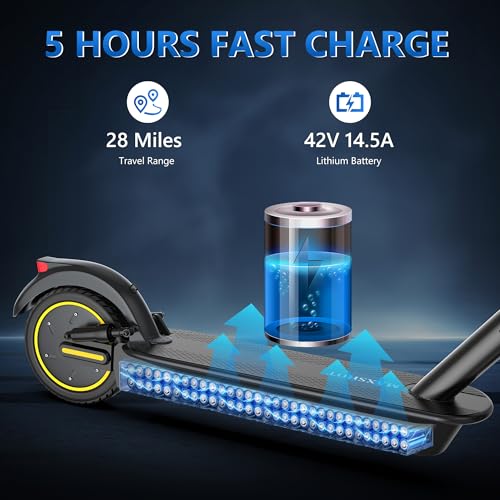

The MAXSHOT V1MAX Electric Scooter is a high-performance ride designed for adults who want long range and smooth comfort. With its 500W motor, it reaches speeds of up to 22 mph while handling inclines with ease. The powerful 14.5Ah battery supports up to 28 miles per charge, making it ideal for longer commutes. Its 10-inch solid tires and dual suspension system ensure stability and comfort, even on rough roads. Safety is a priority with UL-2272 certification, dual braking, non-slip deck, and ultra-bright LED lights. Weighing just 36 lbs and folding in seconds, the MAXSHOT Electric Scooter is perfect for both city travel and storage convenience.
The V1MAX model is equipped with a 500W brushless motor reaching speeds of 22 mph and a 42V/10.5Ah battery supporting up to 22 miles per charge. With a maximum load capacity of 265 pounds, this scooter suits both teens and adults for commuting or recreational rides. It features 10-inch maintenance-free honeycomb tires combined with a dual shock-absorbing suspension system for stability on rough city streets. The scooter includes UL 2272 certification, dual braking system with regenerative and drum brakes, LED display, and smartphone app control for adjusting riding modes and monitoring scooter status.
- Powerful Motor: 500W motor with speeds up to 22 mph and strong hill-climbing ability.
- Long Range: 14.5Ah battery delivers up to 28 miles per charge.
- Smooth Ride: Dual suspension and 10” solid tires absorb shocks for stability.
- Charging Time: Full recharge may take several hours.
- Heavier Build: At 36 lbs, portability may be challenging for some riders.
- Firm Tires: Solid tires provide durability but less cushioning than air-filled ones.
RelayWay R Pro Off-Road Electric Scooter


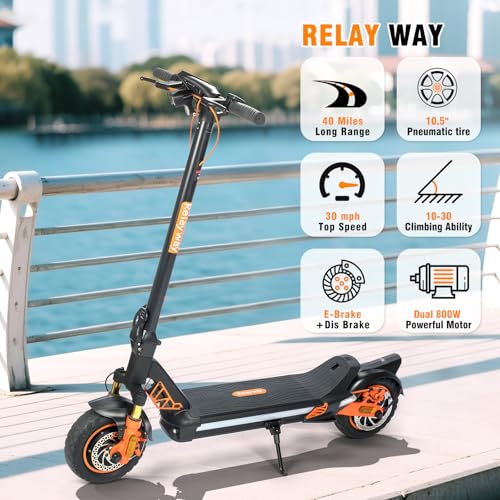
Wondering “can two people ride an electric scooter”? The RelayWay R Pro is designed for adult riders who demand power, stability, and off-road capability. With a dual motor system delivering up to 3200W, this scooter reaches speeds up to 30 MPH and supports riders up to 400 lbs, making it possible for two average-sized adults to ride safely under optimal conditions.
If you’ve ever asked, “can two people ride an electric scooter?”, the RelayWay R Pro might be the closest option—but with caution. Engineered for adult riders, this heavy-duty scooter supports up to 400 lbs, which could theoretically accommodate two average-sized adults. However, for safety, the manufacturer recommends single-rider use only, as handling and braking performance are optimized for one person.
- High Weight Capacity: Supports up to 400 lbs, allowing for potential two-person rides under safe conditions
- All-Terrain Capability: Dual suspension and 10.5" tires handle off-road and urban surfaces confidently
- Long Range & Foldable Design: Up to 40 miles per charge and easy 3-step folding for portability
- Heavy Scooter: Durable frame and dual motors make it less portable for lifting
- Pricey Option: Higher cost than single-rider scooters due to heavy-duty components
- Not Certified for Two-Person Use: Manufacturer advises adult single-rider use for safety
JOYOR S5/S10/T10 Electric Scooter
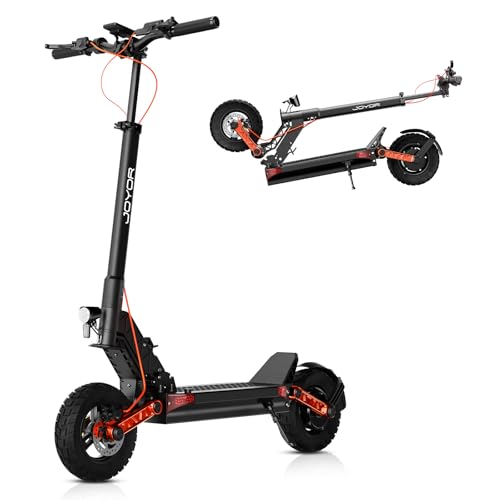
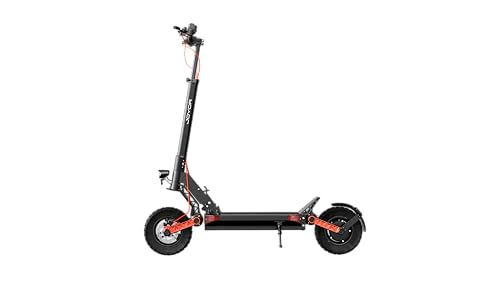

Wondering “can two people ride an electric scooter”? The JOYOR S5/S10/T10 series is engineered for adult riders seeking power, versatility, and off-road capability. With motors ranging from 600W to 2000W, these scooters reach top speeds of 31–44 MPH and support a maximum load of 330 lbs, making them strong enough to consider two-person riding under careful conditions.
If you’ve ever asked, “can two people ride an electric scooter?”, the JOYOR S5/S10/T10 series is a high-performance option built for adults. With a maximum load of 330 lbs, it’s strong enough to accommodate two average-sized adults in careful, controlled riding situations.
- High Performance: 600W–2000W motors with speeds up to 44 MPH for fast, smooth rides
- Off-Road Stability: Dual suspension and 10" tires handle rough terrain confidently
- Long Range & Foldable: Up to 48 miles per charge with 3-second fold for easy portability
- Weight Considerations: Extra load may slightly reduce top speed and acceleration
- Reduced Maneuverability: Two-person riding requires extra care when turning or braking
- Heavier to Lift: Durable construction makes the scooter less easy to carry for transport
Premium Performance Scooter
Designed for serious riders, this electric scooter offers a 350-pound capacity with a powerful 800W motor that reaches speeds up to 25 mph. The scooter includes advanced safety features such as regenerative braking, triple braking system, and integrated turn signals. Its wider-than-average deck and reinforced frame provide enhanced stability, while the digital display shows real-time speed, battery level, and riding mode. The pneumatic tires and dual suspension system ensure smooth rides even on rough urban surfaces.
Understanding Weight Capacity and Design Limitations
Electric scooters are precision-engineered vehicles with specific design parameters. The weight capacity listed by manufacturers isn’t arbitrary—it represents the maximum load the scooter’s frame, motor, battery, and braking system can safely handle. Standard electric scooters typically accommodate between 220 and 265 pounds, though some heavy-duty models extend this to 350 pounds or more.
When two people attempt to ride a single scooter, the combined weight often exceeds these limits. This overloading affects multiple systems simultaneously. The motor must work harder to move the extra weight, draining the battery faster and potentially causing overheating. The frame experiences stress beyond its design specifications, risking structural failure or permanent deformation. Most critically, the braking system, calibrated for a specific weight range, becomes significantly less effective.
The deck size on most electric scooters measures between 6 to 8 inches wide and 15 to 20 inches long—barely sufficient for one person to stand comfortably. Adding a second rider forces both individuals into awkward, unstable positions that compromise balance and control. The center of gravity shifts dramatically, making the scooter prone to tipping, especially during turns or when encountering uneven surfaces.
Safety Concerns and Risk Factors
Safety concerns with dual riding extend beyond simple weight calculations. The primary rider maintains control of acceleration, braking, and steering, while the passenger must hold on and adjust their position to maintain balance. This creates a coordination challenge where both riders must move in harmony, something particularly difficult when encountering obstacles, making sudden stops, or navigating turns.
Braking distance increases substantially with additional weight. A scooter that normally stops within 10 feet might require 15 to 20 feet or more when carrying two people. This extended stopping distance becomes dangerous in urban environments with pedestrians, vehicles, and unexpected obstacles. Emergency braking situations become particularly hazardous as the added momentum makes the scooter more difficult to control.
The handlebar design on electric scooters assumes a single rider’s grip and weight distribution. When a second person holds onto the primary rider or the handlebars, it interferes with steering control and balance adjustments. In emergency situations requiring quick maneuvering, this interference can prevent the driver from avoiding collisions or maintaining control.
Visibility also becomes compromised. The passenger’s body position may block the primary rider’s view of the road, traffic, or obstacles. Conversely, other road users may not anticipate two people on what appears to be a single-rider vehicle, leading to misjudgments about speed, braking, and space requirements.
Legal and Regulatory Considerations
Legal frameworks governing electric scooters vary significantly by location, but most jurisdictions address the issue of passengers. Many cities and states explicitly prohibit carrying passengers on electric scooters unless the device is specifically designed and rated for multiple riders. Violations can result in fines ranging from $50 to several hundred dollars, depending on local ordinances.
Rental scooter companies universally prohibit double riding in their terms of service. Riders who violate this policy risk account suspension, additional fees, and liability for any accidents or damage that occurs. These companies implement this rule not only for safety but also to comply with local regulations and insurance requirements.
Insurance implications also deserve consideration. Personal injury or property damage resulting from double riding may not be covered by standard policies if the practice violated manufacturer guidelines or local laws. This leaves riders personally liable for medical expenses, property damage, and legal fees resulting from accidents.
Some jurisdictions allow children to ride with adults under specific conditions, such as weight limits, helmet requirements, and designated riding areas. However, these exceptions typically apply only to scooters explicitly rated for such use and require adherence to strict safety protocols.
When Two-Person Riding Might Be Acceptable
Legitimate scenarios exist where two people can share an electric scooter safely and legally. Purpose-built dual-rider scooters feature extended decks, higher weight capacities, reinforced frames, and enhanced braking systems. These models clearly specify their two-person rating and include design elements like extended handlebars, dual foot positions, and upgraded suspension systems.
Adults transporting young children represent another acceptable scenario, provided the total weight remains within limits and local laws permit it. The child should stand in front of the adult, within the adult’s arms and control reach. Helmets for both riders are essential, and speed should be significantly reduced. This arrangement works best for short distances in controlled environments rather than busy streets or high-traffic areas.
Some specialized electric scooters designed for accessibility or specific purposes include seating for two people. These differ significantly from standard standing scooters and are engineered specifically for dual occupancy. They feature wider wheelbases, more powerful motors, and enhanced stability systems that make them fundamentally different from standard models.
Alternatives to Double Riding
Rather than risking safety and legal complications, several alternatives provide better solutions for two people needing electric scooter transportation. The most straightforward option involves each person using their own scooter. Many cities offer rental services making this approach convenient and cost-effective, while the independence allows riders to travel at their own pace and comfort level.
Tandem-style electric scooters, though less common, provide purpose-built solutions for two riders. These specialized vehicles feature elongated frames, dual standing positions, and systems designed to accommodate multiple riders safely. While more expensive than standard models, they offer legitimate dual-riding capability.
Electric bikes with passenger seats or cargo areas present another alternative. E-bikes generally offer better stability with two people, have higher weight capacities, and more commonly include features specifically designed for carrying passengers. Many jurisdictions also have clearer and more permissive regulations regarding passengers on electric bicycles compared to scooters.
For short distances or specific situations, ride-sharing services or public transportation might prove more practical than attempting to share a single scooter. These options eliminate safety concerns and legal risks while often providing more comfortable transportation for both parties.
Mechanical Impact and Long-Term Consequences
The mechanical toll of double riding extends beyond immediate safety concerns. Electric scooter components wear faster under excess load, leading to premature failure and costly repairs. The motor, designed for specific weight parameters, strains under additional load, generating excess heat that degrades internal components. This stress shortens motor life and can lead to sudden failure during operation.
Battery performance also deteriorates more rapidly when consistently overloaded. The power demands of moving extra weight drain batteries faster, reducing range and requiring more frequent charging cycles. Over time, this accelerated cycling degrades battery capacity permanently, diminishing the scooter’s overall lifespan and usability.
Structural components face similar challenges. The deck, stem, and folding mechanisms experience forces beyond their design specifications, leading to stress fractures, loose connections, and eventual failure. These structural issues may not be immediately apparent but accumulate over time, creating dangerous situations where components fail suddenly during use.
Tires and suspension systems wear unevenly and rapidly under excess weight. Tires may develop flat spots or sidewall damage, while suspension components lose their effectiveness and may leak or fail entirely. These degraded systems compromise ride quality and safety even when the scooter carries only a single rider.
Manufacturer Guidelines and Warranty Implications
Electric scooter manufacturers provide clear guidelines regarding weight limits and passenger restrictions for good reason. These specifications emerge from extensive testing and engineering analysis to ensure safe operation. Violating these guidelines not only creates safety hazards but also voids product warranties.
Most warranty agreements explicitly state that damage resulting from misuse, including exceeding weight limits or carrying unauthorized passengers, will not be covered. This means that repairs or replacements for scooters damaged by double riding become the owner’s financial responsibility. Given that motor replacements can cost several hundred dollars and frame damage may render a scooter irreparable, these warranty exclusions represent significant financial risk.
Manufacturers also disclaim liability for accidents or injuries resulting from use outside specified parameters. This legal protection means that users injured while double riding cannot hold manufacturers responsible, leaving them to bear medical costs and other accident-related expenses personally.
Reading and understanding the user manual that accompanies each electric scooter is essential. These documents clearly outline weight limits, passenger restrictions, and proper use guidelines. Following these recommendations ensures safe operation and maintains warranty coverage.
Best Practices for Scooter Safety
Whether riding solo or considering dual occupancy on an appropriate model, certain safety practices remain universal. Always wear a helmet regardless of local laws or riding conditions. Head injuries represent the most severe risk associated with scooter accidents, and helmets significantly reduce injury severity.
Regular maintenance ensures optimal performance and safety. Check tire pressure, brake function, and battery condition before each ride. Inspect the frame, stem, and deck for cracks, loose bolts, or other signs of wear. Addressing minor issues prevents them from becoming serious problems during operation.
Ride defensively and assume other road users may not see or anticipate your movements. Maintain safe speeds appropriate for conditions, traffic, and your skill level. Avoid distractions like phone use while riding, and keep both hands on the handlebars except when signaling turns.
Understanding local laws and regulations helps avoid legal complications. Research rules specific to your area regarding where scooters can operate, speed limits, helmet requirements, and passenger restrictions. Compliance protects both legal standing and personal safety.
The Environmental and Practical Perspective
Electric scooters appeal partly due to their environmental benefits and practical convenience. These advantages diminish when scooters are misused or damaged through improper operation. A scooter damaged by overloading requires premature replacement, negating some environmental benefits through increased manufacturing demand and waste.
From a practical standpoint, double riding often proves inefficient. The reduced speed, range, and handling make trips longer and less convenient than using separate scooters or alternative transportation. The mental stress of maintaining balance and control with a passenger detracts from the enjoyment and ease that make electric scooters attractive.
Community perception also matters. Unsafe riding practices contribute to negative public opinion about electric scooters, potentially leading to stricter regulations or bans that affect all users. Responsible riding promotes positive perceptions and helps ensure continued access to this valuable transportation option.
Conclusion
The question of whether two people can ride an electric scooter involves more complexity than a simple yes or no answer. While physically possible on many models, the practice introduces significant safety risks, legal complications, and mechanical stress that make it inadvisable in most situations. Standard electric scooters lack the design features, weight capacity, and structural integrity necessary for safe dual occupancy.
For those genuinely needing to transport two people via electric scooter, purpose-built dual-rider models offer the only truly safe and legal option. These specialized scooters incorporate the engineering and safety features necessary for carrying passengers. Alternatively, each person using their own scooter provides better safety, performance, and legal compliance.
Understanding manufacturer specifications, respecting weight limits, and following local regulations protects both personal safety and legal standing. Electric scooters represent an excellent transportation solution when used as intended—by individual riders within design parameters. By making informed, responsible choices about electric scooter use, riders can enjoy the benefits of this technology while maintaining safety for themselves and others sharing the road.
Frequently Asked Questions
What is the maximum weight limit for most electric scooters?
Most standard electric scooters have weight limits between 220 and 265 pounds, though some heavy-duty models can accommodate up to 350-400 pounds. These limits include the rider’s weight plus any cargo or accessories. Exceeding the specified weight limit compromises safety, reduces performance, voids warranties, and can damage the scooter’s motor, battery, frame, and braking systems. Always check the manufacturer’s specifications for the specific model being used and ensure the total weight remains within the stated capacity.
Are there electric scooters specifically designed for two riders?
Yes, specialized dual-rider electric scooters exist but are less common than single-rider models. These scooters feature extended decks, reinforced frames, higher weight capacities, more powerful motors, and enhanced braking systems specifically engineered for two people. They often include wider wheelbases for better stability and longer decks with designated standing positions for both riders. However, these models cost more than standard scooters and may have different regulatory classifications in some jurisdictions.
Can adults ride with small children on electric scooters?
Some jurisdictions and scooter models allow adults to ride with small children under specific conditions. The combined weight must remain within the scooter’s capacity, local laws must permit it, and both riders should wear helmets. The child should stand in front of the adult within their control reach. However, this should only be done on scooters rated for such use, at reduced speeds, and in controlled environments rather than busy streets. Many areas prohibit this practice entirely, so checking local regulations is essential.
What are the penalties for carrying a passenger on a rental scooter?
Penalties vary by location and rental company but typically include immediate fines ranging from $50 to $200, account suspension or permanent banning from the service, and liability for any damage or injuries that occur. Rental companies may also charge the full replacement cost of the scooter if it’s damaged during double riding. Additionally, local jurisdictions may impose separate fines for violating traffic laws regarding electric scooter passengers, which can add several hundred dollars to the total penalty.
How does carrying extra weight affect an electric scooter’s performance?
Extra weight significantly impacts multiple performance aspects. The motor works harder, causing faster battery drainage and reduced range—sometimes by 40-60%. Acceleration decreases noticeably, and hill-climbing capability diminishes substantially. Braking distance increases, sometimes doubling the space needed to stop safely. The frame experiences additional stress that can cause permanent deformation or cracking. Tires wear faster and may fail prematurely. Handling becomes less responsive, and stability decreases, particularly during turns or on uneven surfaces. Overall, the scooter’s lifespan shortens considerably under regular overloading.