Electric Scooter Error Codes Explained and How to Fix Common Problems
*We may earn a commission for purchases made using our links. Please see our disclosure to learn more.
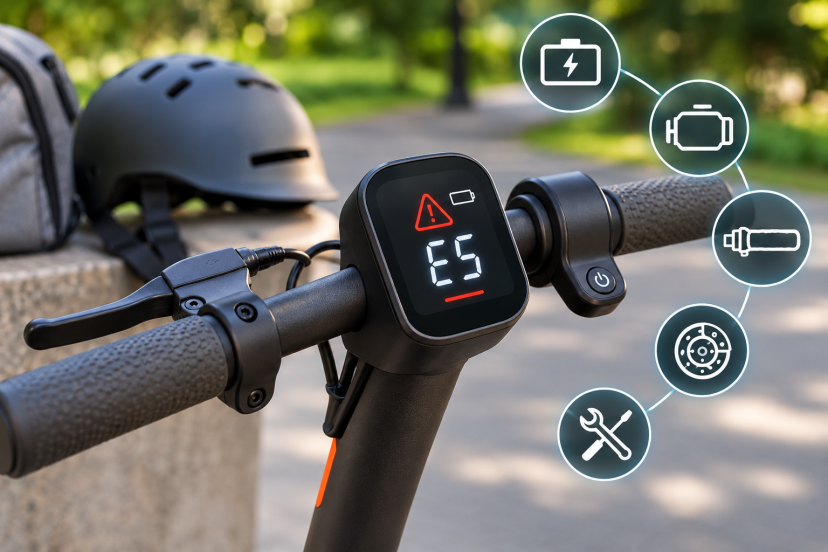
Electric scooter error codes help riders identify problems with their scooter’s battery, motor, throttle, brakes, or electronic control system. These codes usually appear on the dashboard when the scooter detects an electrical or mechanical fault.
An error code does not always mean that a major component needs replacing. Some warnings appear because of temporary overheating, low battery voltage, or an interrupted connection. Others indicate problems that require professional repairs before the scooter can be used safely.
However, electric scooter error codes are not universal. A code displayed on a Segway scooter may have a completely different meaning on a GOTRAX, Hiboy, or NIU model.
Understanding the exact error message, identifying the affected component, and following the manufacturer’s recommendations can help prevent unnecessary repairs and further damage.
This guide covers common electric scooter error codes, brand-specific fault charts, safe troubleshooting procedures, and ways to prevent recurring problems.
“Always be present when charging micromobility products, never while sleeping, and only use the supplied charger.”
— U.S. Consumer Product Safety Commission (CPSC)
Key Takeaways
- Electric scooter error codes identify possible problems involving the battery, motor, controller, throttle, brakes, or communication system.
- Codes such as E1, E2, and E5 can have different meanings depending on the scooter’s brand and model.
- Some temporary warnings may clear after a safe restart or after the scooter cools down.
- Battery, motor, braking, and controller faults may require professional inspection or replacement parts.
- Always consult the manufacturer’s error code chart before attempting repairs, and never continue riding a scooter with a safety-critical fault.
Four Electric Scooters Worth Considering
For riders considering a replacement or an upgrade, these four electric scooters offer different combinations of commuting performance, battery range, and support resources.
A new scooter is not necessarily the solution to an error code. Repairing a safe, serviceable scooter may be more economical.
1. Segway Ninebot MAX G3


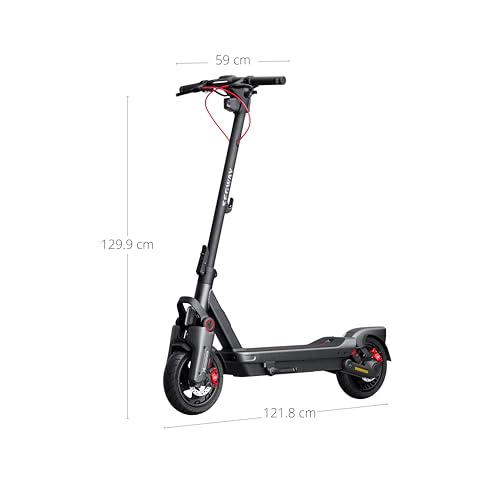
The Segway Ninebot Max G3 is one of the quietest electric scooters designed for riders who value both silence and performance. Featuring a powerful 2000W peak motor, a top speed of 28 mph, and a max range of 50 miles, this scooter delivers smooth, noise-free rides perfect for city commutes or long-distance travel. With dual hydraulic suspension, advanced stability systems, and self-sealing 11-inch tires, the G3 ensures comfort and safety while keeping road noise at a minimum. Its fast charging system (3.5 hours standard, 2.5 hours with optional DC charger) makes it ideal for daily use. Certified under UL-2272 safety standards, it’s a reliable option for adults and teens seeking premium quality and peace of mind.
- Quiet Ride: Low-noise motor and smooth suspension make it one of the quietest electric scooters for urban commutes.
- Long Range: Up to 50 miles per charge, ideal for extended rides without frequent recharging.
- Comfort & Stability: Dual hydraulic suspension and self-sealing tires absorb shocks for a smoother, quieter journey.
- Premium Price: Higher cost compared to entry-level scooters.
- Heavy Frame: Weighs more than lightweight commuter models, less portable.
- Non-Returnable: Limited return options due to hazardous material regulations.
The Segway Ninebot MAX G3 is designed for riders who want a commuter scooter with suspension and longer-distance capability.
Its notable features include 10-inch self-sealing tubeless tires, front and rear suspension, a digital dashboard, and companion app functionality.
Segway also publishes technical documentation that explains several diagnostic codes, making it easier to identify faults and communicate with authorized service providers.
It is worth considering for regular commuters who value ride comfort and access to model-specific troubleshooting information.
2. GOTRAX G4 Electric Scooter


The Gotrax Electric Scooter for Adults is a powerful, long-range commuting scooter designed for daily travel and delivery services. Featuring a 500W motor, it can reach speeds of up to 20 mph and cover a maximum range of 42 miles (depending on the model). Its 10" pneumatic tires provide excellent stability and shock absorption, ensuring a smooth ride on different terrains. The scooter also boasts a removable 36V 10.4AH battery that offers great value for extended usage, and it includes safety features such as an electric code lock and a cable lock for easy security. With its foldable design, digital display, and LED lights, the Gotrax electric scooter makes commuting or delivery tasks more convenient and efficient.
- Long range: Up to 42 miles on a single charge, making it ideal for long-distance travel and delivery.
- Powerful motor: The 500W motor allows for smooth acceleration and a top speed of 20 mph.
- Pneumatic tires: 10" pneumatic tires offer better stability, comfort, and shock absorption, especially on rough roads.
- Weight: It weighs 36 lbs, which may be heavy for some users to carry.
- Charging time: A full charge can take several hours, which might not be ideal for high-frequency use.
- Price: On the higher end for budget-conscious buyers, especially for the longer-range models.
The GOTRAX G4 is a folding commuter scooter equipped with a 500-watt motor and a manufacturer-stated top speed of 20 mph.
GOTRAX advertises up to 25 miles of range under specified riding conditions, although actual range depends on speed, terrain, and rider weight.
The G4 features a digital display and an integrated locking mechanism.
A notable advantage for troubleshooting is GOTRAX’s published error-code documentation, which identifies faults affecting its controller, motor, battery, and handlebar assembly.
3. Hiboy S2 Pro Electric Scooter


The Hiboy S2 Pro and S2 Max are commuter-friendly electric scooters built with comfort and quiet performance in mind. Featuring a 500W brushless hub motor, these scooters reach speeds of up to 19 mph with ranges from 25 to 40.4 miles depending on the model. The 10-inch solid tires and rear dual shock absorbers provide a smooth, stable ride while keeping noise levels low, making them some of the quietest electric scooters in their price range. Additional features include a foldable design for portability, ultra-bright headlights for safety, and app connectivity to lock your scooter or customize ride settings.
- Quiet & Smooth Ride: Solid tires with dual rear suspension reduce noise and absorb shocks for comfortable commuting.
- App Connectivity: Hiboy app allows locking, acceleration adjustments, and braking customization.
- Portable Design: Foldable frame makes it easy to carry and store in compact spaces.
- Moderate Speed: Max speed capped at 19 mph, slower than premium models.
- Weight Limit: Supports up to 220 lbs, less than higher-capacity scooters.
- Solid Tires: While maintenance-free, they provide less cushioning than pneumatic tires.
The Hiboy S2 Pro is a foldable scooter designed for urban commuting.
It includes a 500-watt motor, 10-inch honeycomb solid tires, rear suspension, and a manufacturer-stated maximum speed of 19 mph.
Hiboy advertises up to 25 miles of range under favorable conditions.
The solid tires eliminate routine inflation and reduce puncture-related maintenance, although they do not prevent other mechanical or electrical problems.
Hiboy also provides a model-specific diagnostic table for the S2 Pro, covering error codes E1 through E9.
4. NIU KQi 100P Electric Scooter

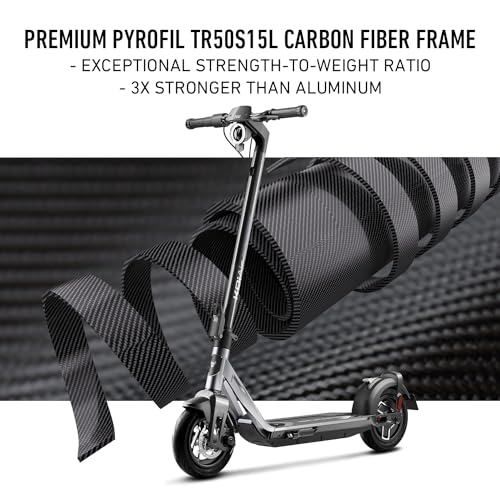
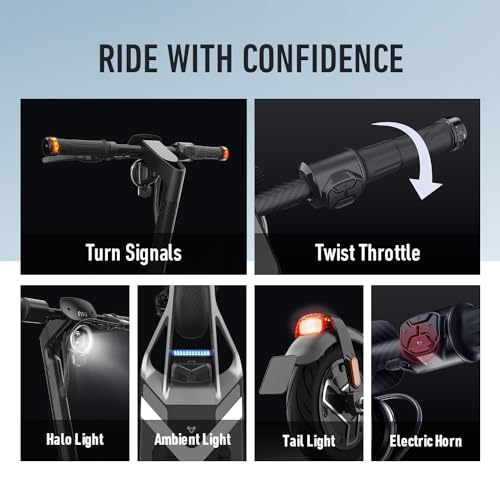
The NIU KQi Air Electric Scooter combines a lightweight carbon-fiber frame with practical performance for commuting and short urban trips. Weighing only 26.2 pounds, it is easier to carry up stairs, place in a vehicle, or take on public transportation than many full-size electric scooters.
- Lightweight Design: Weighs only 26.2 pounds for easier carrying and storage.
- Strong Commuter Range: Provides a claimed maximum range of up to 31 miles.
- Smart Safety Features: Includes turn signals, lighting, an electric horn, NFC unlocking, and dual braking.
- Premium Price: Costs more than many entry-level commuter scooters.
- Limited Customer Rating: The listed 2.9-star Amazon rating may concern some buyers.
- App Dependence: Some security and monitoring features require the NIU mobile app.
The NIU KQi 100P is aimed at riders looking for an approachable commuter scooter with app-based functions.
It features a 300-watt rated motor, front suspension, 9.5-inch pneumatic tires, and a manufacturer-stated top speed of 17.4 mph.
NIU advertises an 18-mile maximum range under its test conditions.
Its companion app provides access to connected features, while the manufacturer maintains technical support resources for troubleshooting.
The KQi 100P is a practical model to compare for shorter commutes, particularly where comfort and straightforward daily operation matter.
When comparing scooters, also review the warranty, replacement-part availability, relevant electrical safety certification, and the manufacturer’s support process.
What Are Electric Scooter Error Codes?
Electric scooter error codes are diagnostic messages generated by the scooter’s electronic systems when abnormal conditions are detected.
Modern electric scooters contain several electrical components that communicate with one another. These may include a battery management system (BMS), motor controller, throttle sensor, brake sensors, display, and motor Hall sensors.
When a component sends an unexpected signal or stops communicating correctly, the controller may trigger an error message.
The error can appear as a number, a combination of letters and numbers, or a flashing warning symbol.
For example, some models display codes such as E1 or E5, while certain Segway Ninebot scooters use numerical codes such as 14, 18, and 21.
Why Error Codes Differ Between Models
There is no single diagnostic standard used by every electric scooter manufacturer.
Even models from the same brand can use different error code systems. GOTRAX, for instance, publishes separate fault lists for its GXL V2, G4, G5, and GX series.
This means searching for an error number without identifying the scooter model can lead to incorrect troubleshooting advice.
The safest approach is to record the complete code, confirm the model name, and compare the message against the appropriate user manual or manufacturer support page.
Common Electric Scooter Error Codes and Their Meanings
The following table summarizes the major types of scooter faults. These are general diagnostic categories, not universal definitions for individual error numbers.
| Error category | Possible problem | Recommended action |
|---|---|---|
| Battery error | Low voltage, battery communication failure, or battery protection warning | Check the model-specific instructions and charging conditions |
| Motor error | Motor signal failure, damaged sensors, or motor malfunction | Stop riding and arrange an inspection |
| Throttle error | Faulty accelerator sensor or throttle connection | Check for an obstructed throttle and seek service if the fault persists |
| Brake error | Brake lever sensor failure or electronic braking problem | Do not ride until braking is verified |
| Controller error | Controller malfunction, excess current, or overheating | Power off and seek diagnosis |
| Communication error | Interrupted connection between electronic components | Check approved external connections or contact support |
| Temperature error | Battery, motor, or controller operating outside its permitted range | Allow the scooter to return to a safe temperature |
An error code identifies an area that needs attention, but it does not necessarily identify the exact failed part.
For example, an apparent motor problem could involve the motor itself, a damaged cable, or the controller responsible for operating it.
Segway Ninebot Electric Scooter Error Codes
Segway Ninebot electric scooters use diagnostic codes to identify problems involving electronic sensors, the battery, controller, and motor.
The following examples come from the Ninebot KickScooter MAX G3 manual. Check the documentation for your exact model and regional version before using this chart.
| Error code | Meaning | Recommended action |
|---|---|---|
| 10 | Dashboard communication failure | Check the dashboard connection through authorized service |
| 14 | Abnormal throttle Hall sensor reading | Check whether the throttle was pressed during startup |
| 15 | Abnormal brake Hall sensor reading | Check whether the brake lever was held during startup |
| 18 | Abnormal motor Hall signal | Have the motor sensor connections inspected |
| 21 | Battery communication failure | Have the battery communication connection inspected |
| 24 | Abnormal battery voltage reading | Contact service to inspect battery-to-controller connections |
| 35 | Default scooter serial number detected | Contact authorized service for identification verification |
| 39 | Abnormal battery temperature | Check operating conditions and contact service |
| 40 | Controller temperature sensor abnormality | Stop riding and allow the system to cool |
| 41 | Motor temperature sensor abnormality | Contact authorized service |
How to Troubleshoot Segway Error Code 14
Error code 14 on the MAX G2 indicates an abnormal accelerator Hall sensor reading.
If the throttle was held down while the scooter was starting, the controller may detect an unexpected input.
Turn the scooter off, release the throttle completely, and make sure it returns freely to its normal position. Restart the scooter without pressing the accelerator.
If the code returns, a faulty throttle sensor or connection may need professional inspection.
How to Troubleshoot Segway Error Code 21
Error code 21 indicates a battery communication problem on the MAX G2.
The scooter’s controller may not be receiving the expected information from the battery system.
Because the issue involves battery communication wiring, riders should avoid opening the battery compartment or attempting electrical repairs without appropriate training.
Contact Segway support or an authorized technician if the warning persists.
GOTRAX Electric Scooter Error Codes
GOTRAX scooters use different diagnostic code sets depending on the product series.
The manufacturer’s official error code reference provides separate definitions for its models.
GOTRAX GXL V2, Vibe, and Apex Error Codes
| Error code | Meaning |
|---|---|
| E1 | Communication failure |
| E2 | Brake lever failure |
| E3 | Handlebar assembly failure |
| E4 | Motor failure |
| E5 | Controller or body-end failure |
For these models, GOTRAX identifies the connection between the console and battery as a possible cause of several faults.
The manufacturer describes cleaning the relevant connector or replacing the console as potential solutions. However, users unfamiliar with electrical disassembly should request service rather than opening the scooter themselves.
Motor and controller failures generally require replacement of the affected components.
GOTRAX G3, G4, GMAX, and GMAX Ultra Error Codes
| Error code | Meaning |
|---|---|
| 1 | Controller failure |
| 2 | Handlebar or console failure |
| 3 | MOSFET-related controller failure |
| 4 | Motor signal failure |
| 5 | Brake lever failure |
| 6 | Motor blocking fault |
| 7 | Battery undervoltage |
| 8 | Battery overvoltage |
These codes illustrate why identifying the exact scooter model matters.
For example, E2 on a GOTRAX GXL V2 indicates a brake lever fault, whereas code 2 on a GOTRAX G4 refers to the handlebar or console assembly.
Both may affect scooter operation, but their recommended repairs differ.
Battery voltage, blocked motor, and controller errors should be assessed by qualified technicians rather than treated as routine reset problems.
Hiboy Electric Scooter Error Codes
Hiboy’s S2 and S2 Pro scooters use diagnostic codes for brake, throttle, communication, battery, and motor faults.
The following definitions are documented in the Hiboy S2 and S2 Pro manual and should not automatically be applied to other Hiboy models.
| Error code | Meaning | Manufacturer-guided response |
|---|---|---|
| E1 / F1 | Brake error | Brake lever replacement may be required |
| E2 / F2 | Throttle error | Throttle replacement may be required |
| E3 | Display-to-controller communication problem | Service may be needed for the display and connection cable |
| E4 | Overcurrent protection | Allow cooling; repeated faults require service |
| E5 | Low-voltage protection | Charge using the approved charger if safe to do so |
| E6 | Overvoltage protection | Stop riding and follow model-specific service advice |
| E7 | Motor Hall sensor error | Have motor sensor connections checked |
| E8 | Motor phase error | Motor repair or replacement may be required |
| E9 | Hardware error | Restart as directed; persistent faults require service |
What Hiboy Error Code E5 Means
On the Hiboy S2 and S2 Pro, E5 indicates low-voltage protection.
If the scooter has been operating normally and its battery is simply depleted, charging with the manufacturer-approved charger may clear the warning.
However, repeated low-voltage errors can indicate battery deterioration or another electrical problem.
If the scooter has been damaged, exposed to water, or shows unusual battery behavior, do not attempt to recharge it before professional inspection.
What Hiboy Error Code E4 Means
E4 indicates an overcurrent protection event on the S2 and S2 Pro.
This may temporarily disable electronic braking and throttle operation.
Hiboy states that the warning may disappear once the scooter cools. If it returns repeatedly, controller replacement may be needed.
Avoid riding while the warning remains active.
NIU Electric Scooter Error Codes
NIU scooters can also display fault messages related to acceleration, battery condition, and other electrical systems.
The NIU troubleshooting FAQ identifies two examples:
| Error code | Meaning | Recommended action |
|---|---|---|
| 03 | Accelerator fault | Check the accelerator condition and arrange service if necessary |
| 41 | Battery over-discharge warning | Follow NIU’s charging instructions and contact support if unresolved |
These examples come from NIU’s general support guidance. Confirm their applicability to your specific model before attempting any repair.
NIU Error Code 03
This warning relates to an accelerator fault in the applicable NIU models.
The manufacturer recommends checking the accelerator switch and its connections. If the problem continues, submit a service request.
Do not attempt to bypass the accelerator sensor or modify the controller to eliminate the warning.
NIU Error Code 41
NIU identifies code 41 in its general troubleshooting guide as a battery over-discharge warning.
It can occur after a scooter has remained unused for an extended period.
For an otherwise undamaged scooter, NIU recommends charging promptly. If charging fails or the warning continues, request support.
A battery that is swollen, leaking, unusually hot, or physically damaged should never be charged.
How to Fix an Electric Scooter Error Code Safely
Before replacing components, follow a basic diagnostic process.
Step 1 – Identify the Exact Code
Take a clear picture of the dashboard.
Write down the scooter’s full model name and note whether the message appeared during startup, acceleration, braking, charging, or riding uphill.
If the scooter has a companion app, check whether it provides a more detailed fault description.
Step 2 – Stop Riding
Do not continue riding while a brake, throttle, motor, battery, or controller fault is active.
A scooter that suddenly loses power or responds unpredictably to the throttle can create a serious accident risk.
Move it to a safe location and switch it off according to the manufacturer’s instructions.
Step 3 – Check for Visible Damage
Examine the scooter without opening its electrical enclosure.
Look for damaged cables, an obstructed throttle, a brake lever that does not return properly, cracks near the motor, or signs of moisture around external connectors.
Do not touch exposed conductors or attempt to repair a damaged battery.
Step 4 – Restart Only When Appropriate
If the manufacturer identifies the fault as potentially temporary, a normal power cycle may help.
Wait until the scooter has cooled if the warning involves temperature or excess current.
Then restart it without pressing the accelerator or brake unless the manual specifically instructs otherwise.
If the fault returns, further troubleshooting is necessary.
Step 5 – Inspect Charging Conditions
For low-battery warnings, verify that the scooter is dry, undamaged, and within its approved charging temperature range.
Use only the supplied or manufacturer-approved charger.
Never substitute a charger merely because its plug fits. Incorrect electrical specifications can damage the battery or create a fire hazard.
Step 6 – Contact Support
If the warning continues, provide customer support with the error code, model, serial number, purchase information, and a description of what happened.
A short video showing the dashboard and symptoms may help the technician diagnose the problem.
Avoid replacing expensive components before the manufacturer has identified the likely cause.
Electric Scooter Problems That May Occur Without Error Codes
Not every mechanical or electrical issue generates a dashboard warning.
Scooter Turns On but Does Not Move
Possible causes include an activated electronic lock, an engaged brake sensor, a throttle problem, or a motor controller fault.
Some scooters also require an initial push before the accelerator becomes active.
Check the user manual to determine whether the scooter uses a kick-start feature. Never assume the motor is damaged simply because the scooter does not accelerate from a standstill.
Scooter Shuts Off While Riding
Unexpected shutdowns may result from low battery charge, thermal protection, damaged connections, or internal electrical faults.
If shutdowns happen repeatedly, stop using the scooter and arrange an inspection.
Scooter Will Not Charge
A charging problem may involve the power outlet, charger, charging port, battery management system, or battery pack.
Check only the external items permitted by the manufacturer. Never open the battery casing, bypass its protection circuit, or attempt to charge individual lithium-ion cells.
Scooter Loses Power on Hills
Climbing requires additional motor power, which can increase heat and electrical demand.
Excess rider weight, steep slopes, low charge, and prolonged high-power riding can contribute to reduced performance.
Follow the manufacturer’s grade and load limits. If power loss is sudden or repeatedly accompanied by an error, seek service.
When Should You Stop Troubleshooting and Call a Professional?
Some error codes indicate problems that should not be handled through basic home troubleshooting.
Professional assistance is particularly important when:
- The scooter’s brakes do not function correctly.
- Acceleration continues after the throttle is released.
- The motor locks, vibrates severely, or makes unusual grinding noises.
- The battery becomes swollen, leaks, smokes, or produces an unusual odor.
- The scooter repeatedly shuts off while riding.
- An electrical fault returns after the manufacturer’s approved checks.
Battery-related issues deserve special caution.
The U.S. Consumer Product Safety Commission warns about fire hazards associated with improperly manufactured, damaged, or incompatible lithium-ion battery systems.
It also advises consumers to choose micromobility products designed and certified to applicable safety standards.
For electric scooters, UL 2272 is an important electrical system safety standard to look for when comparing products.
Certification helps reduce electrical and fire risks, but it does not eliminate every possible malfunction.
How to Prevent Electric Scooter Error Codes
Regular maintenance cannot prevent every electronic failure, but it can help reduce avoidable problems.
Keep the Scooter Clean and Dry
Remove dust and dirt using the manufacturer’s recommended cleaning methods.
Avoid pressure washing, submerging electrical components, or allowing moisture to collect around charging ports and external connectors.
A water-resistance rating should not be treated as permission to ride through deep water.
Follow Proper Charging Practices
Use the approved charger and follow the manufacturer’s charging instructions.
Avoid charging a damaged scooter or battery. Keep charging equipment away from combustible materials and unplug the charger when charging is complete.
Follow the manufacturer’s specified temperature limits for charging and storage.
Avoid Excessive Loads
Every scooter has a maximum permitted rider weight and operating limits.
Carrying loads above those limits or repeatedly climbing slopes beyond the scooter’s capabilities can increase mechanical and electrical stress.
Check Brakes and Tires Regularly
Inspect brake operation before riding.
For pneumatic tires, maintain the manufacturer’s recommended pressure. Underinflated tires can reduce efficiency and increase the load on the motor.
Check that wheels rotate normally and that the folding mechanism remains secure.
Keep Software Updated
For scooters with companion apps, check for official software or firmware updates.
Follow the manufacturer’s update instructions and avoid unofficial controller modifications that could change safety functions or complicate future repairs.
Frequently Asked Questions
1. What does E1 mean on an electric scooter?
E1 does not have a universal meaning. On the GOTRAX GXL V2, Vibe, and Apex, it indicates a communication failure. On the Hiboy S2 Lite, it can also relate to communication between the display and controller, while the Hiboy S2 and S2 Pro use E1/F1 for a brake fault.
Always confirm the scooter model before interpreting E1.
2. Why does my electric scooter show E2?
The meaning of E2 depends on the manufacturer. On certain GOTRAX models, E2 indicates a brake lever problem. On Hiboy S2 and S2 Pro scooters, E2/F2 indicates a throttle fault.
Check the correct user manual and avoid riding until the affected control system has been evaluated.
3. Can I reset an electric scooter error code?
Some temporary error messages can clear after a normal restart, charging, or cooling period when the manufacturer permits those steps.
However, a reset does not repair damaged wiring, a defective sensor, or a failed controller. Repeated warnings require diagnosis rather than repeated resets.
4. Why is my electric scooter beeping and flashing an error code?
Beeping and flashing can indicate a diagnostic fault, low battery condition, alarm, or another model-specific warning.
Record the displayed code and check the manual. If braking, acceleration, or motor operation is affected, stop using the scooter until the cause is identified.
5. Is it safe to ride an electric scooter with an error code?
Not without confirming what the warning means and whether the manufacturer permits continued operation.
Codes involving braking, acceleration, motor control, battery abnormalities, or overheating can indicate unsafe riding conditions.
When in doubt, switch the scooter off and contact the manufacturer or a qualified repair technician.
Understanding Error Codes Helps Keep Your Scooter Safe
Electric scooter error codes provide useful information about possible mechanical and electrical problems, but interpreting them correctly requires more than matching a number to a generic chart.
The most reliable approach is to identify the scooter model, consult its official diagnostic documentation, and perform only the checks recommended by the manufacturer.
Simple problems may be resolved through approved charging, cooling, or restart procedures. Persistent motor, brake, battery, and controller faults require proper diagnosis.
Regular maintenance, compatible charging equipment, and timely professional repairs can help extend the scooter’s useful life while reducing avoidable safety risks.