Apple AirTag vs. GPS Tracker for Electric Scooter Theft: Which Is Better?
*We may earn a commission for purchases made using our links. Please see our disclosure to learn more.
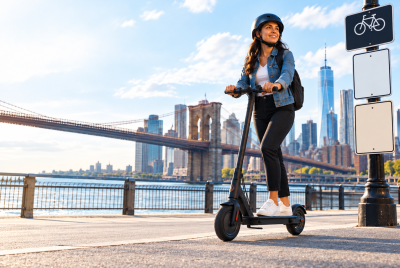
Electric scooters are compact, valuable, and relatively easy to move, making theft protection an important consideration for owners who regularly park outside homes, offices, stores, transit stations, or college buildings.
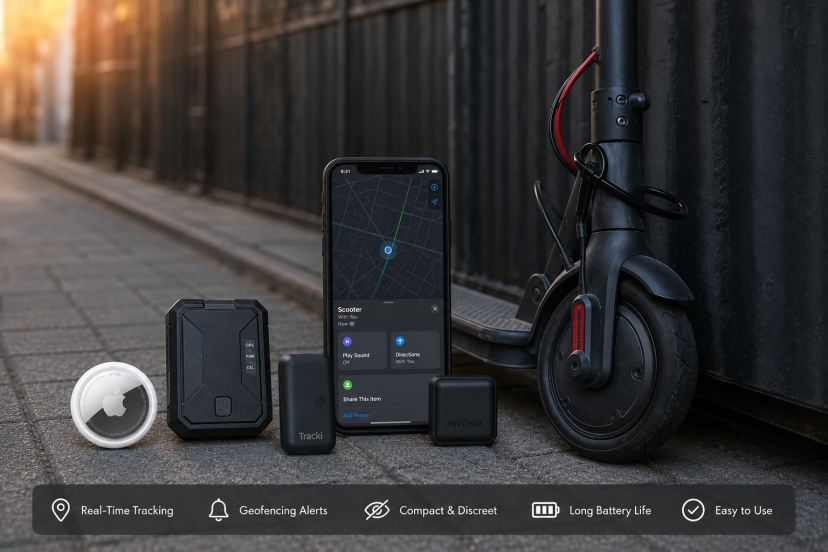
A strong lock remains the first line of defense, but locks cannot tell you where a scooter has gone after it disappears. Adding a hidden tracking device may provide useful location information that can be shared with law enforcement. The two most common options are an Apple AirTag and a cellular GPS tracker.
Although both devices can display a scooter’s location on a map, they work very differently. An AirTag relies on nearby Apple devices to detect its Bluetooth signal and anonymously update its location through the Find My network. A GPS tracker calculates its position using satellite signals and normally transmits that information through a cellular connection.
That difference affects update frequency, battery life, subscription costs, installation, coverage, privacy features, and the likelihood of recovering a stolen scooter. Neither option guarantees recovery, but choosing the right tracker, and installing it as part of a layered security setup, can improve your chances.
“Your AirTag sends out a secure Bluetooth signal that can be detected by nearby devices in the Find My network.”
— Apple
Key Takeaways
- An AirTag is best for affordable, low-maintenance backup tracking. It does not require a monthly cellular plan and its replaceable battery can last more than a year.
- A GPS tracker is usually better for active theft recovery. It can provide frequent location updates, movement notifications, geofences, and location history without depending on nearby iPhone users.
- AirTag updates are crowd-dependent. A stolen scooter may update frequently in a busy city but much less often in a remote or sparsely populated area.
- AirTag’s anti-stalking features can expose it. A person traveling with an unfamiliar AirTag may receive a warning, and the tag may eventually play a sound.
- The strongest approach combines several protections. Use a high-quality lock, secure parking practices, a visible deterrent, and a concealed tracker rather than relying on one device.
AirTag vs. GPS Tracker at a Glance
| Feature | Apple AirTag | Cellular GPS Tracker |
|---|---|---|
| Tracking method | Bluetooth and the Find My network | GPS positioning and cellular data |
| Monthly subscription | No | Usually required |
| Location updates | Occur when detected by nearby network devices | Frequently transmitted according to plan and settings |
| Live movement tracking | Limited | Usually available |
| Battery life | More than one year | Several days to several months |
| Battery type | Replaceable coin-cell battery | Usually rechargeable |
| Movement alerts | Limited separation notifications | Commonly available |
| Geofencing | No conventional geofence system | Usually available |
| Location history | Limited | Usually included |
| Best environment | Busy areas with many Apple devices | Areas with GPS visibility and cellular coverage |
| Smartphone compatibility | Primarily Apple devices for ownership and tracking | Usually iOS, Android, and web |
| Main weakness | May alert the person carrying it | Requires charging and a paid plan |
Four Recommended Trackers for Electric Scooters
1. Apple AirTag, Second Generation — Best Without a Subscription
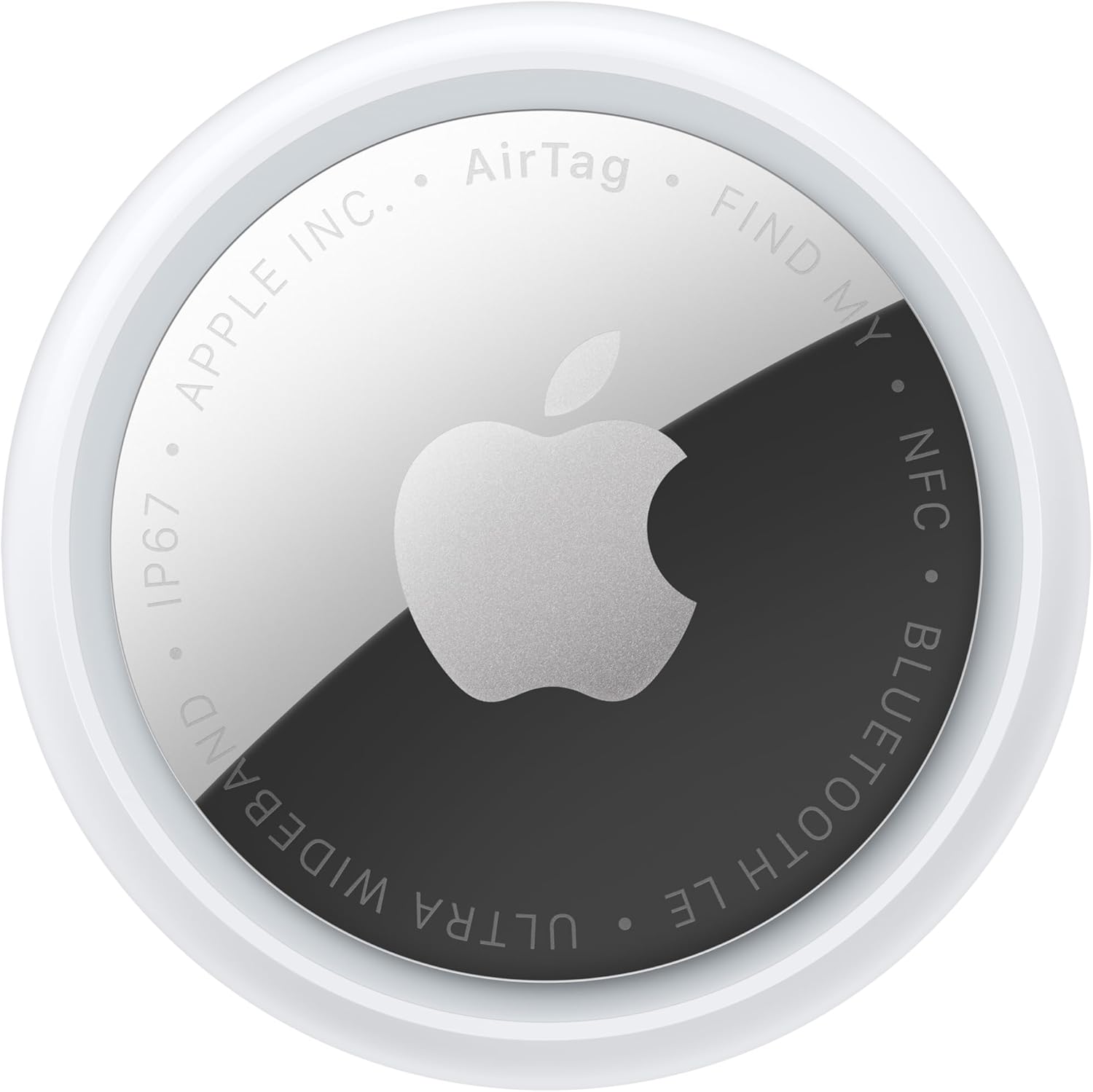


The Apple AirTag (2nd Generation) is a compact Bluetooth tracker designed to help locate keys, wallets, bags, electric scooters, and other valuable belongings through Apple’s Find My network. It connects to an iPhone or iPad with a simple one-tap setup and provides step-by-step Precision Finding directions when the tracker is nearby.
- Long Battery Life: Operates for more than a year on an easily replaceable battery.
- Expanded Finding Range: Improved Bluetooth and Ultra Wideband technology help locate items from farther away.
- Simple Apple Integration: Connects quickly to the Find My app on compatible Apple devices.
- Apple Devices Only: Designed primarily for iPhone, iPad, and Apple Watch users.
- No True GPS Tracking: Location updates depend on nearby devices in the Find My network.
- May Alert a Thief: Anti-stalking notifications and the louder speaker can reveal a concealed AirTag.
The Apple AirTag is the most practical choice for owners who want inexpensive backup tracking with little maintenance.
The second-generation model offers expanded Precision Finding, a louder speaker, an IP67 water- and dust-resistance rating, and more than one year of battery life from a replaceable CR2032 battery.
Why it works for scooters:
- Small enough for many concealed holders
- No monthly plan
- Long replaceable-battery life
- Large crowdsourced finding network
- Lost Mode notifications
- Useful close-range Precision Finding
Main drawback: It is not a real-time GPS tracker, requires Apple’s Find My ecosystem for ownership and location monitoring, and may warn the person moving with it.
Best for: iPhone owners who want an affordable secondary recovery tool.
2. Tracki Mini GPS Tracker — Best Compact GPS Option


The Tracki Mini GPS Tracker is a compact 4G LTE tracking device designed for vehicles, electric scooters, motorcycles, luggage, bags, and other valuables. Measuring approximately 1.77 by 1.46 by 0.55 inches and weighing 1.26 ounces, it is small enough for concealed or low-profile installation.
- Compact Design: Small enough to conceal inside many scooter compartments or accessories.
- Useful Security Alerts: Includes movement, speed, geofence, and location notifications.
- Flexible App Access: Works with iOS, Android, web browsers, and supported Alexa devices.
- Subscription Required: Ongoing cellular service fees are necessary for tracking.
- Frequent Charging: Active battery life is typically limited to five to seven days.
- Not Fully Waterproof: Outdoor use may require a separate waterproof enclosure.
The Tracki Mini is significantly smaller than many vehicle trackers, making it easier to place inside a scooter enclosure when sufficient protected space is available.
It uses a subscription-supported 4G LTE connection and can provide app-based location updates, movement alerts, geofences, speed alerts, and other notifications. The current model is approximately 1.77 by 1.46 by 0.55 inches and can provide one-minute automatic updates or faster manual location requests. Its standard battery is rated for approximately five to seven days of active operation, depending on settings and use.
Why it works for scooters:
- Compact and lightweight
- Frequent location updates
- Movement and geofence alerts
- Replaceable rechargeable battery
- iOS, Android, and browser access
- Optional battery and weather-protection accessories
Main drawback: The standard device is not fully waterproof without the appropriate enclosure, and the relatively short active battery life requires a disciplined charging schedule.
Best for: Owners who prioritize compact size and active tracking over long intervals between charges.
3. LandAirSea 54 — Best Rugged Magnetic Tracker


The LandAirSea 54 GPS Tracker is a compact, rechargeable tracking device designed for vehicles, electric scooters, ATVs, golf carts, and other valuable assets. Its built-in magnet allows discreet attachment to compatible metal surfaces, while the waterproof housing helps protect the device during outdoor use.
- Fast Location Updates: Provides tracking intervals as frequent as every three seconds.
- Rugged Construction: Features a waterproof housing and integrated magnetic mount.
- Detailed Tracking History: Stores route and location playback for up to one year.
- Subscription Required: Cellular tracking requires an ongoing monthly or annual plan.
- Charging Still Needed: Battery performance varies based on movement and update frequency.
- Magnet May Need Backup: Scooter vibration may require an additional secure mounting method.
The LandAirSea 54 is a compact, round GPS tracker with a built-in magnet and an IP67-rated enclosure. It supports real-time alerts, geofencing, location history, and cellular tracking through a required subscription. The manufacturer lists battery life of up to approximately 14 days under typical settings, although actual performance depends heavily on movement and update frequency.
Why it works for scooters:
- Water-resistant IP67 construction
- Integrated magnet
- Movement and geofence notifications
- Location-history features
- Compact vehicle-oriented design
- Suitable for frequent outdoor exposure
Main drawback: Magnetic attachment alone may not be secure enough for a scooter exposed to vibration, potholes, curbs, and rough pavement. It should be mechanically secured inside an appropriate enclosure whenever possible.
Best for: Larger scooters with enough protected room for a rugged tracker.
4. Tracki Pro GPS Tracker — Best for Long Battery Life


The Tracki Pro GPS Tracker is a long-battery tracking device designed for cars, electric scooters, motorcycles, trailers, boats, equipment, and other valuable assets. Its large 10,000mAh rechargeable battery can provide approximately two to seven months of active tracking with one- to five-minute updates or up to 12 months in sleep mode, depending on movement, signal strength, and settings.
- Extended Battery Life: Operates for months between charges under suitable tracking settings.
- Comprehensive Alerts: Provides movement, speed, impact, geofence, idle-time, and battery notifications.
- Secure Mounting Options: Includes a strong magnet and screw mount for flexible installation.
- Subscription Required: Continued tracking depends on a paid cellular service plan.
- Bulky Construction: Its 3.54-by-2.48-by-1.46-inch body may not fit compact commuter scooters.
- Slower Updates Save Power: Using frequent location updates can significantly shorten battery life.
The Tracki Pro sacrifices compactness in exchange for substantially longer battery life. It contains a 10,000mAh battery and is marketed for several months of active use, depending on update settings, or longer periods in sleep mode.
It includes a built-in magnet, weather-resistant construction, movement alerts, geofencing, route history, speed monitoring, and app-based location updates through a required cellular subscription.
Why it works for scooters:
- Much longer battery life than most miniature trackers
- Frequent tracking intervals
- Movement, impact, speed, and geofence alerts
- Weather-resistant enclosure
- Strong magnetic and screw-mounting options
- Useful for scooters stored for extended periods
Main drawback: At roughly 3.54 by 2.48 by 1.46 inches, it is too large for many lightweight commuter scooters. It is more suitable for a large deck, cargo scooter, seated scooter, removable battery enclosure, or another model with substantial interior space.
Best for: Owners of larger scooters who want fewer charging interruptions.
How Does an Apple AirTag Track an Electric Scooter?
An AirTag does not contain a conventional GPS receiver or cellular modem. Instead, it continuously sends an encrypted Bluetooth signal.
When a participating iPhone, iPad, or Mac passes close enough to detect that signal, the device can anonymously report the AirTag’s approximate location to Apple’s Find My network. The owner can then view that location in the Find My app. Apple says the process is encrypted and designed so that neither the passing device’s owner nor Apple can see who owns the AirTag.
This crowdsourced system can work particularly well in:
- Dense residential neighborhoods
- Downtown business districts
- College campuses
- Transit stations
- Shopping centers
- Apartment buildings
- Other places with frequent pedestrian or vehicle traffic
Suppose someone takes a scooter through a city containing many compatible Apple devices. Its AirTag may be detected multiple times along the route, giving the owner a series of useful location updates.
However, updates are not guaranteed or continuous. If the scooter enters a warehouse, rural road, private garage, basement, shipping container, or another area without participating devices nearby, its location may remain unchanged until it is detected again.
Precision Finding
When the owner gets physically close to an AirTag, compatible Apple devices can use Precision Finding to display its approximate direction and distance.
The second-generation AirTag introduced in 2026 has upgraded Bluetooth and Ultra Wideband hardware, an expanded Precision Finding range, and a louder speaker. Apple says its Precision Finding range can extend up to 50% farther than the previous generation.
This can be useful when locating a misplaced scooter in a crowded parking facility. During a theft, however, owners should give location information to police rather than entering private property or confronting a suspected thief.
The Biggest AirTag Limitation: Anti-Stalking Alerts
Apple designed AirTag to locate personal belongings, but it also includes protections intended to discourage someone from secretly tracking another person.
When an AirTag remains separated from its owner and appears to be moving with someone else, that person may receive an unwanted-tracking notification on a compatible iPhone or Android device. The AirTag may also begin playing a sound after it has been away from its owner for a period of time.
These protections are important for personal safety, but they create a disadvantage during scooter theft. A thief may:
- Receive a tracker warning
- Hear the AirTag’s speaker
- Search the scooter for the device
- Remove or destroy the AirTag
- Abandon the scooter after discovering it
The newer AirTag’s louder speaker makes lost belongings easier to locate, but it may also make a concealed tag easier for a thief to discover.
For this reason, an AirTag should be treated as a recovery aid rather than a dedicated anti-theft GPS system.
How Does a GPS Tracker Work?
A conventional GPS tracker uses satellite signals to estimate its location. It then transmits that location through a cellular network to the manufacturer’s app or online platform.
GPS itself is a U.S.-owned positioning, navigation, and timing system. Consumer tracking devices combine that positioning capability with mobile data service so owners can view updates remotely.
Depending on the model and service plan, a GPS tracker may offer:
- Location updates every few seconds or minutes
- Movement or vibration alerts
- Geofence notifications
- Speed information
- Route and location history
- Low-battery warnings
- Multiple-user access
- Email, app, or text notifications
These capabilities make GPS trackers more suitable for monitoring a scooter that is actively moving.
For example, a movement alert may notify you shortly after someone begins rolling or carrying the scooter. You can check its location, confirm that the movement is unauthorized, report the theft, and begin saving screenshots before the scooter travels far from its original location.
Does GPS Provide True Real-Time Tracking?
“Real-time” does not always mean that a tracker updates every second.
The actual interval may be 10 seconds, 30 seconds, one minute, five minutes, or longer. Faster intervals normally consume more battery and may require a higher-priced service plan. When the tracker stops moving, many models enter a power-saving mode and reduce their update frequency.
GPS performance can also decline:
- Inside buildings
- Under concrete structures
- Between tall buildings
- Beneath dense metal surfaces
- Inside shipping containers
- In underground parking areas
- Where cellular service is unavailable
Even so, a GPS tracker normally provides more consistent movement tracking than an AirTag because it does not have to wait for an unrelated phone or computer to pass nearby.
Is AirTag or GPS Better for Electric Scooter Theft?
For theft recovery alone, a cellular GPS tracker is generally the stronger option. It provides more frequent updates, movement alerts, historical routes, and greater control over tracking intervals.
An AirTag is better when the owner wants:
- No monthly subscription
- Minimal maintenance
- A small device
- Long battery life
- Simple integration with an iPhone
- An inexpensive secondary tracker
A GPS tracker is better when the owner wants:
- Early movement notifications
- Frequent location updates
- Location history
- Geofences
- Cross-platform access
- Less dependence on nearby smartphones
The right answer also depends on the scooter’s design. Some slim commuter scooters have very little protected space inside the deck or stem. A small AirTag may be easier to conceal. Larger scooters with deep decks, storage compartments, or substantial frames may have room for a rechargeable GPS unit.
Where Should You Install a Tracker?
The tracker should be difficult to see and remove without reducing its ability to receive or transmit signals.
Possible locations include:
- Inside a hollow stem with appropriate clearance
- Beneath a removable deck cover
- Inside a controller compartment, away from excessive heat
- Behind a nonmetallic trim panel
- Beneath an accessory mount
- Inside a purpose-built tracker holder
- Near the battery enclosure without touching terminals or wiring
Do not place a tracker where it can:
- Interfere with steering
- Contact moving components
- Damage electrical insulation
- Block ventilation
- Compress battery cells
- Compromise a water-resistant seal
- Create a rattling object inside the deck
- Short-circuit electrical connections
Large metal structures can weaken Bluetooth, GPS, and cellular signals. Before relying on an installation, park the scooter in several realistic locations and verify that the tracker continues to report accurately.
An external magnetic tracker also needs a secondary retention method. Scooter vibration and road impacts can dislodge a tracker even when the magnet initially feels secure.
Should You Use Both an AirTag and GPS Tracker?
For a high-value scooter, using both can provide useful redundancy.
A GPS tracker can deliver early movement warnings and frequent location updates. A separately concealed AirTag can serve as a backup if the GPS tracker loses cellular coverage, runs out of power, or is discovered and removed.
Using two trackers also allows different charging schedules. The AirTag may continue operating for more than a year, while the GPS tracker handles active monitoring.
The two devices should not be installed together. If a thief discovers one tracker, they may continue searching the immediate area for another. Place them in separate concealed locations when the scooter’s construction safely permits it.
A Tracker Does Not Replace a Good Lock
A tracker helps after unauthorized movement has occurred. A lock is intended to prevent or delay that movement.
For better protection:
- Lock the scooter frame rather than only the wheel
- Attach it to a fixed, immovable object
- Use a hardened U-lock or heavy-duty chain
- Keep the lock away from the ground
- Avoid leaving the scooter outside overnight
- Choose visible, well-lit locations
- Park near active entrances or security cameras
- Record the scooter’s serial number
- Photograph identifying marks and accessories
- Keep the purchase receipt and model information
- Enable any built-in electronic locking or alarm features
Cable locks are convenient but should generally be treated as secondary protection rather than the only lock on an expensive scooter.
What to Do If Your Electric Scooter Is Stolen
First, confirm that the scooter was not moved by building management, security personnel, a family member, or another authorized person.
Then:
- Contact the police. Use emergency services when the crime is in progress or someone is in danger. Otherwise, follow the local department’s non-emergency reporting procedure.
- Provide the serial number. Include the brand, model, color, distinctive accessories, photographs, and purchase records.
- Share tracker evidence. Save screenshots showing the location, timestamps, travel direction, battery status, and location history.
- Keep monitoring from a safe location. Do not enter private property or follow the suspected thief.
- Report the theft to your insurer. Coverage may come from a dedicated policy, renters insurance, homeowners insurance, or another applicable policy.
- Notify relevant property staff. Ask nearby businesses, building managers, transit facilities, or campus security to preserve camera footage.
Government police guidance consistently warns people not to approach or confront suspected thieves. Your safety is more important than recovering the scooter personally.
Which Tracker Should You Choose?
Choose an Apple AirTag when you want a small, affordable tracker with no subscription and minimal battery maintenance. It is especially attractive for iPhone users in densely populated areas, but its crowd-dependent updates and anti-stalking warnings limit its effectiveness as a dedicated theft tracker.
Choose a cellular GPS tracker when recovering a stolen scooter is the main objective. Movement alerts, regular updates, geofencing, and location history provide more actionable information during the first minutes and hours after a theft.
For valuable or frequently parked scooters, the strongest setup is often a concealed GPS tracker supported by a separately installed AirTag. Combine them with a high-quality lock, careful parking, an alarm, identifying records, and a plan for reporting theft.
No tracker can guarantee recovery. Its role is to provide timely evidence—not to encourage an owner to pursue a thief.
Frequently Asked Questions
1. Can an Apple AirTag track a stolen electric scooter in real time?
Not in the same way as a cellular GPS tracker. An AirTag’s location updates when nearby devices in Apple’s Find My network detect its Bluetooth signal. Updates may be frequent in crowded areas but delayed in locations with few participating devices. A GPS tracker can transmit updates according to a set interval whenever it has suitable GPS and cellular coverage.
2. Will a thief know that my scooter has an AirTag?
Possibly. Apple and Google support unwanted-tracker alerts that can notify someone when an unfamiliar tracker appears to be moving with them. An AirTag separated from its owner may also play a sound. These features protect people from stalking but can help a thief locate and remove a concealed tag.
3. Do GPS trackers for electric scooters require a subscription?
Most cellular GPS trackers require a subscription because they use a mobile data connection to transmit location information to an app or website. The subscription may also support location history, alerts, customer service, and server access. AirTag does not require a monthly tracking plan because it uses the Find My network.
4. Can I put a GPS tracker inside an electric scooter deck?
Potentially, provided there is sufficient space and the tracker does not contact the battery, controller, wiring, seals, or moving components. Metal deck construction may reduce GPS and cellular performance, while controller and battery heat may affect the tracker. Test the location thoroughly and consult a qualified scooter technician when opening the deck could affect safety or warranty coverage.
5. Should I follow the tracker location myself after my scooter is stolen?
No. Record the location, take screenshots, update the police, and remain in a safe place. Tracker information may be delayed or imprecise, and the scooter could be inside private property or near someone who is armed. Never confront a suspected thief or attempt to recover the scooter by force.