Electric Scooter Water Resistance Ratings
*We may earn a commission for purchases made using our links. Please see our disclosure to learn more.
Electric scooters have become one of the most popular personal transportation options in recent years, offering a clean, efficient, and affordable way to get around town. But as more riders rely on them for daily commutes, one question comes up time and again: can they handle the rain? Understanding water resistance ratings is essential for any scooter owner or buyer, especially in regions where wet weather is common. This guide breaks down everything needed to make sense of those cryptic IP codes stamped on spec sheets.
“Water ingress is one of the leading causes of premature failure in personal electric vehicles. Consumers should always check the IP rating before purchasing and understand that even rated products have limitations under sustained exposure.”
Source: Electric Vehicle Safety Council, Technical Report on Micromobility Durability Standards
Key Takeaways
- IP (Ingress Protection) ratings are the global standard for measuring how well a device resists dust and water.
- The second digit in an IP rating specifically refers to water protection, ranging from 0 (no protection) to 9 (high-pressure water resistance).
- Most consumer electric scooters fall between IPX4 and IP65, making them splash-resistant but not fully waterproof.
- Riding through deep puddles or heavy rain can void warranties and damage electronics, even on scooters with moderate IP ratings.
- Proper storage and maintenance extend the water resistance of any electric scooter over time.
What Is an IP Rating?
IP stands for Ingress Protection, and it is defined by the international standard IEC 60529. The rating consists of two digits: the first indicates protection against solid particles like dust and debris, while the second addresses liquid ingress. When a rating includes an “X” in place of a digit, it means that particular category was not tested.
For example, IPX4 means the scooter has not been rated for dust but has been tested to withstand water splashing from any direction. Meanwhile, IP65 means it is fully dust-tight and can handle low-pressure water jets from any angle.
The rating system was developed to give manufacturers and consumers a consistent, universally understood language for describing how a product holds up against environmental conditions. Without it, terms like “water-resistant” and “waterproof” would be left entirely to interpretation, which often leads to misleading marketing claims.
Breaking Down the Water Resistance Scale
The second digit in an IP rating tells you how well a device is protected against water. For electric scooters, this number matters because rain, puddles, wet roads, and cleaning habits can all affect the scooter’s electrical components, battery, motor, display, throttle, brakes, and wiring.
The water resistance scale runs from 0 to 9K, with each level based on a different type of water exposure test. A higher number generally means better protection, but it does not always mean the scooter is safe to ride in all wet conditions. Electric scooters still have moving parts, charging ports, seams, cables, and components that can be damaged if water gets inside.
Here is what each level means in practical terms.
IPX0: No Water Protection
IPX0 means there is no water protection at all. A scooter with this rating, or no stated water resistance rating, should be kept away from moisture as much as possible.
This type of scooter should not be ridden in rain, through puddles, or on wet roads. Even light moisture may create a risk if water reaches the battery compartment, controller, display, or charging port. Riders should also avoid storing it outdoors, in damp garages, or anywhere condensation may build up.
IPX1: Protection Against Vertical Drips
IPX1 protects against vertically falling water droplets. This is a very low level of protection and is roughly equivalent to light dripping from above.
For an electric scooter, this does not mean it is suitable for rain. It may handle a small amount of moisture falling directly downward, but it offers little protection against angled rain, puddle spray, road splash, or water hitting the scooter while riding. In real-world use, IPX1 is only slightly better than no protection.
IPX2: Protection Against Light Angled Drips
IPX2 protects against water droplets falling at up to a 15-degree angle. This gives slightly more protection than IPX1, but it is still very limited.
A scooter with this rating may tolerate small amounts of dripping water from a slight angle, but it is not designed for wet commutes or rainy rides. Since scooters move forward while riding, water rarely falls straight down. It often splashes from the front wheel, road surface, or passing vehicles, which makes IPX2 too weak for most outdoor wet-weather use.
IPX3: Protection Against Spraying Water
IPX3 protects against water sprayed at up to a 60-degree angle. This is a step up from drip protection and may help against very light rain or occasional spray.
However, IPX3 is still not ideal for regular riding in wet conditions. It may offer some protection if you get caught in a short drizzle, but it should not be treated as rainproof. Road splash, puddles, and water thrown upward from the tires can expose the scooter to more direct moisture than this rating is designed to handle.
IPX4: Protection Against Splashes From Any Direction
IPX4 is one of the most common water resistance ratings found on budget and mid-range electric scooters. It means the scooter can withstand water splashing from any direction.
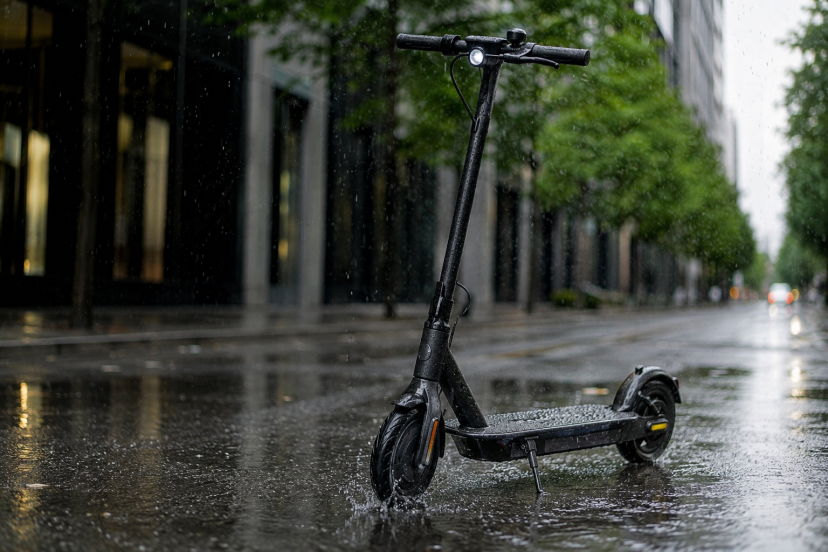
In everyday terms, IPX4 may be enough for light rain, damp roads, and small puddle splashes during normal riding. This rating is often acceptable for riders who may occasionally encounter wet pavement or unexpected drizzle.
However, IPX4 does not mean waterproof. Riders should still avoid deep puddles, heavy rain, pressure washing, or leaving the scooter exposed to storms. Water can still enter through weak points, especially around the charging port, display, deck seams, throttle, or cable openings.
IPX5: Protection Against Low-Pressure Water Jets
IPX5 offers protection against low-pressure water jets from any direction. This is stronger than splash protection and is generally more reassuring for riders who may encounter moderate rain or heavier road spray.
For electric scooters, IPX5 can be useful if you ride in areas where wet streets are common. It may also offer better protection against accidental hose contact during cleaning, although direct spraying should still be avoided when possible.
Even with IPX5, riders should not assume the scooter is safe for deep puddles or prolonged heavy rain. Water resistance also depends on the scooter’s age, condition, seals, and maintenance. A cracked display, loose deck cover, damaged cable, or poorly sealed charging port can reduce real-world protection.
IPX6: Protection Against Powerful Water Jets
IPX6 protects against powerful water jets. This is a much stronger rating and suggests the scooter can handle more forceful water exposure than IPX4 or IPX5.
In practical use, IPX6 gives better confidence in heavy rain, strong road spray, and wetter commuting conditions. It may also make the scooter more resistant to cleaning mistakes, such as brief exposure to stronger water flow.
Still, IPX6 does not mean the scooter can be submerged. A scooter can resist powerful jets and still be damaged if water pools inside the deck, reaches the battery, or enters through the charging port. Riders should still dry the scooter after wet use and avoid intentionally riding through deep standing water.
IPX7: Protection Against Temporary Submersion
IPX7 means the device can withstand temporary submersion in water up to one meter deep for 30 minutes under test conditions. This level is uncommon in electric scooters, though it may appear on certain premium components or higher-end models.
For riders, IPX7 sounds impressive, but it should be interpreted carefully. A scooter with IPX7-rated parts may survive brief water immersion better than lower-rated models, but that does not mean it should be ridden through flooded streets. Submersion can still be risky because electric scooters have multiple components, seals, bearings, connectors, and openings.
If a scooter is rated IPX7, check whether the rating applies to the entire scooter or only certain parts, such as the display or battery enclosure.
IPX8: Protection Against Continuous Submersion
IPX8 means the device is protected against continuous submersion beyond one meter. The exact depth and duration should be specified by the manufacturer.
This rating is rare for electric scooters as a complete vehicle rating. It is more commonly associated with electronics designed for underwater or long-duration wet exposure. If an electric scooter or component claims IPX8 protection, riders should read the manufacturer’s details carefully to understand what was tested and under what conditions.
IPX8 does not automatically mean the scooter can be used like a waterproof vehicle. Tires, brakes, bearings, folding mechanisms, charging ports, and electrical connectors may still be vulnerable.
IPX9K: Protection Against High-Pressure, High-Temperature Water Jets
IPX9K is the highest level on the water resistance scale. It protects against close-range, high-pressure, high-temperature water jets.
This rating is mostly relevant to industrial equipment, vehicles, and machinery that may be cleaned with intense washdown systems. It is not common or usually necessary for consumer electric scooters.
For everyday riders, IPX9K is more than what most commuting scooters need. However, it is useful to understand that even this rating refers to a specific type of water test. It does not always mean every part of a scooter is protected from every possible type of water exposure.
What These Ratings Mean for Electric Scooter Riders
For most electric scooter riders, IPX4 is the minimum rating to look for if you may ride in light rain or on damp roads. IPX5 or IPX6 is better if you live in a rainy area, commute often, or want stronger protection against road spray.
However, no IP rating should be treated as permission to ride carelessly through water. Even scooters with decent water resistance can suffer damage from deep puddles, flooding, pressure washing, or long exposure to rain.
A good rule is simple: water resistance helps protect your scooter from accidental exposure, but it does not make your scooter fully waterproof. Always check the manufacturer’s guidance, cover the charging port securely, avoid deep water, dry the scooter after wet rides, and store it indoors whenever possible.
What Rating Does a Scooter Actually Need?
The appropriate IP rating depends entirely on how and where the scooter is used.
For fair-weather riders who avoid rain altogether, even IPX4 is more than sufficient. These riders are unlikely to encounter anything beyond the occasional splash.
For daily commuters in unpredictable climates, IPX5 or IP55 is a reasonable minimum. These ratings provide a meaningful buffer against light to moderate rain, ensuring the electronics stay protected during unexpected downpours.
For riders in consistently wet environments, such as coastal cities or tropical climates, IP65 or higher is the more prudent choice. These models are built to handle sustained exposure to water without risk to the battery, motor controller, or display.
It is worth noting that no consumer electric scooter should be ridden through standing water deeper than a few centimeters, regardless of IP rating. Submersion testing in lab conditions is controlled and brief; real-world flooding introduces variables that no rating fully accounts for.
The Gap Between Ratings and Real-World Performance
One of the most common misconceptions among electric scooter riders is that an IP rating is a guarantee. It is not. IP ratings reflect the results of standardized laboratory tests conducted under specific conditions with a new product. Several factors can reduce effective water resistance over time:
- Wear and aging: Rubber gaskets, adhesive seals, and O-rings degrade with use. A scooter that was IP65 out of the box may offer significantly less protection after a year of heavy use.
- Crash damage: Even a minor fall can compromise a seal or crack a housing component, creating pathways for moisture that were not there before.
- Improper maintenance: Using high-pressure hoses to clean a scooter rated only for low-pressure water jets, or failing to reseal charge port covers after use, both reduce protection.
- Temperature extremes: Repeated exposure to very hot or very cold conditions can cause materials to expand and contract, weakening seals over time.
This is why checking and maintaining the physical condition of charge port covers, panel seams, and exposed connectors is a regular part of responsible scooter ownership, especially for those who ride in wet conditions frequently.
Common Mistakes Riders Make With Water Exposure
Even experienced riders sometimes underestimate water-related risks. A few patterns come up repeatedly:
Leaving the scooter in the rain while parked. Riding in light rain is one thing, but leaving a scooter parked and exposed during a heavy storm subjects it to prolonged, static water exposure that wears on seals more aggressively than riding does.
Charging immediately after riding in wet conditions. Moisture can linger around the charging port area, and plugging in before allowing the scooter to dry increases the risk of short circuits or corrosion at the connector.
Ignoring puddle depth. Many riders will confidently ride through puddles without considering that wheel spray and road water can reach the battery housing and controller from below. Even a well-rated scooter can be compromised if water is consistently being pushed up into gaps from underneath.
Pressure washing. It seems efficient, but unless the scooter is rated IPX6 or higher, directing a pressurized stream at it strips away lubricants, forces water past seals, and can cause immediate internal damage.
How to Check and Maintain Water Resistance
Staying on top of water resistance does not require specialized tools or technical expertise. A few habits go a long way:
Inspect seals and covers regularly. Look at the charging port flap, display housing, and any visible panel edges. Cracking, lifting, or missing rubber is a signal that resealing is needed.
Use dielectric grease on connectors. Applying a small amount of dielectric grease to exposed electrical connectors helps prevent corrosion and keeps moisture out.
Store indoors or under cover. When not in use, keeping a scooter sheltered from rain and humidity preserves seals and prevents rust on metal hardware.
Dry before charging. After riding in wet conditions, wipe down the scooter and allow it to sit in a dry environment for at least 30 minutes before plugging in.
Avoid submerging regardless of rating. Even IPX7-rated scooters are not designed for repeated submersion. Treat water resistance as a safety margin, not an invitation to test limits.
What to Look for When Buying
When shopping for an electric scooter with reliable water resistance, the IP rating should appear in the official specifications, not just in marketing copy. “Water-resistant” without a corresponding IP code is not a verifiable claim.
Beyond the rating itself, a few other factors indicate better real-world water protection: sealed battery compartments with visible gaskets, recessed or covered charging ports, and conformal coating on the circuit boards (often listed in premium model specs).
Brand reputation and warranty terms are also meaningful signals. A manufacturer willing to cover water damage under warranty is one that stands behind its own IP claims.
Conclusion
Water resistance ratings are not just technical jargon for engineers. They are practical, decision-relevant information for anyone who rides an electric scooter in real-world conditions. Understanding what IP ratings mean, what they do not guarantee, and how to maintain them over time puts riders in a much stronger position to protect their investment and ride safely. Whether commuting through a light drizzle or navigating a rainy city, the right rating paired with sensible habits makes all the difference.
Frequently Asked Questions
1. Is an IPX4-rated scooter safe to ride in the rain?
IPX4 provides protection against water splashing from any direction, which is generally sufficient for light rain and puddle splashes during normal riding. However, it is not designed for heavy downpours or prolonged exposure. Riding cautiously and avoiding deep puddles is still recommended even with this rating.
2. Does a higher IP rating mean the scooter lasts longer in wet conditions?
Generally, yes. Higher-rated scooters are built with better seals, more protected compartments, and materials that hold up against sustained moisture exposure. However, maintenance habits and physical condition also play a significant role in long-term water resistance.
3. Can water resistance be restored after it degrades?
In many cases, yes. Replacing worn gaskets, reapplying sealant around panel edges, and using dielectric grease on connectors can restore a meaningful degree of protection. For major seal failures, a qualified technician may be needed.
4. Does riding in rain void the warranty on my electric scooter?
This varies by manufacturer and model. Some brands explicitly cover water damage up to the stated IP rating, while others exclude all liquid damage regardless of rating. Reviewing the warranty terms before purchasing is strongly advised.
5. Are all parts of a scooter covered by the IP rating?
Not necessarily. An IP rating typically applies to the main unit or specific components tested during certification. Accessories, connectors, and separately attached parts may not carry the same rating. Checking whether the battery and motor controller are independently rated is worth the extra research step.